
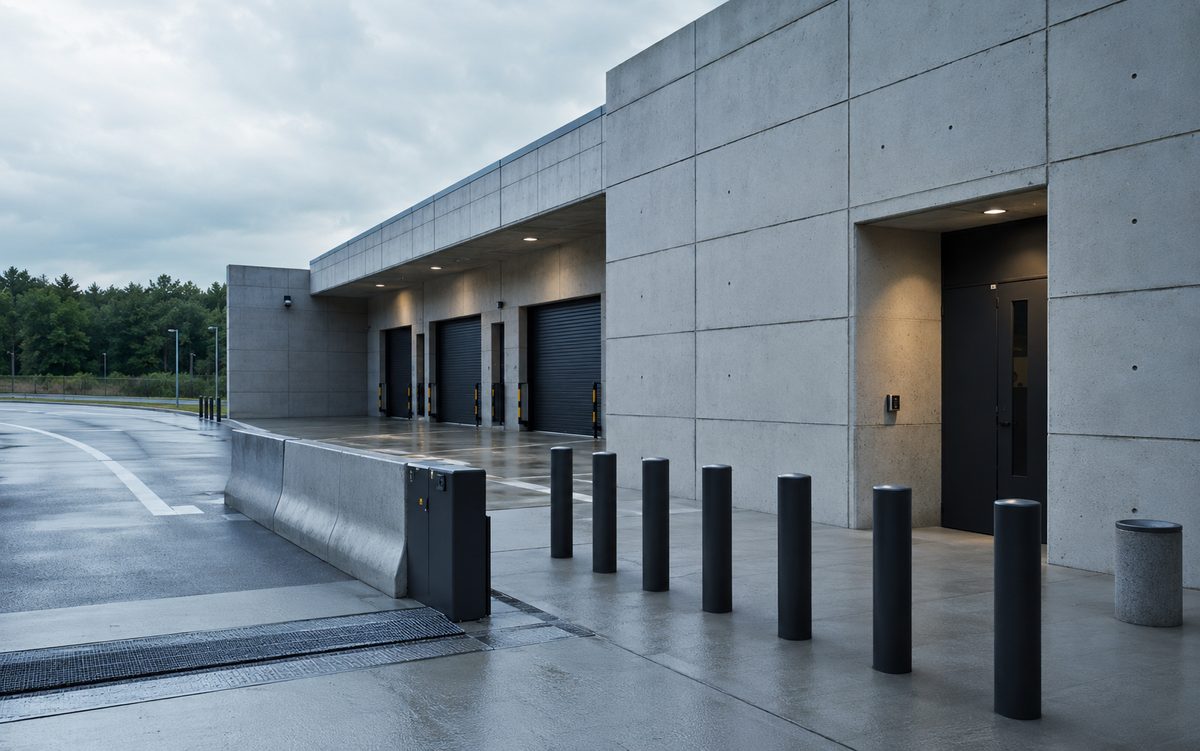
How FEMA, DHS, the U.S. State Department, and Other Agencies Can Use High Performance Shock Absorbing Concretes (HPSAC) to Protect People, Assets, and Operations
Why Federal, State, and Local Agencies should adopt multi‑use facilities built with High Performance Shock Absorbing Concretes (HPSAC). These materials align perfectly with FEMA’s mission to reduce loss of life and property by creating disaster-resilient structures; with DHS’s focus on securing critical infrastructure and public venues; and with the State Department’s need to protect U.S. personnel and assets abroad. By integrating HPSAC into new construction and retrofits, agencies can ensure that vital operations continue during and after crises, avoiding costly and repeated rebuilding.
Across the globe, military emergency management facilities, disaster response hubs, and critical infrastructure sites are being challenged in ways unseen since the height of the Cold War. Long‑range precision projectiles, unmanned aerial systems such as drones, cyber disruption, terrorism and climate‑driven disasters are converging into a threat environment that demands new thinking about infrastructure. The recent use of drones by Ukraine to strike deep into Russian airagency campuses and operational sites underscores how rapidly adversaries can adapt commercially available technology into potent long‑range strike platforms, creating vulnerabilities far from the front line. In this environment, the walls around us are as critical as the weapons in our hands.
High Performance Shock Absorbing Concretes (HPSAC), such as ArmorBlock, Amidon Shield and Amidon eShield from Amidon, are redefining what it means to protect people, missions and equipment. They combine ballistic resistance, blast mitigation, thermal-shock survivability and optional electromagnetic pulse (EMP) and electromagnetic interference (EMI) shielding, all in a permanent, architecturally adaptable package. These materials blend seamlessly into their surroundings, avoiding a fortress-like appearance that might draw unwanted attention. They are inherently passive, requiring no active systems to provide protection and, if damaged, can be fully repaired in place, restoring full capability without costly replacement or extended downtime. In addition to military applications, these materials are ideal for protecting embassies, consulates, border facilities, transportation hubs, utility substations, and data centers. They can be used for crowd control infrastructure that is both protective and non-obtrusive, and for rebuilding disaster-impacted areas with resilience so they do not need to be rebuilt again in the near future.
The opportunities for immediate integration are clear. HPSAC buildings, walls, and bollards can be deployed today at security and access control points for FEMA logistics centers, DHS regional coordination facilities, and State Department compounds. They are equally suited for protecting unmanned aerial systems (UAS) hangars and ground control stations supporting disaster mapping and emergency communications; for securing storage facilities containing sensitive materials, disaster relief supplies, or hazardous substances; for hardening petroleum, oils, and lubricants (POL) fueling points, electrical substations, and supervisory control and data acquisition (SCADA) shelters that manage critical utilities; and for reinforcing medical clinics, community resilience centers, and public gathering spaces in hurricane-, wildfire-, and tornado-prone regions.
The nation’s resilience depends on infrastructure that can withstand whatever comes next, whether natural disaster, terrorism, or unforeseen emergencies. High Performance Shock Absorbing Concrete (HPSAC) has proven its ability to stop ballistic and blast threats; imagine the level of protection it can provide against flying debris from hurricanes and tornadoes. Amidon stands ready to partner with FEMA, DHS, the U.S. State Department, and other agencies to deploy these capabilities now.
To discuss protection for your project with Amidon, get in touch.