
Amidon Labs
Custom Mix Design and Testing, for Hire
Amidon Labs is the R&D engine behind Amidon’s protective materials, offered as a contract service. We design, model, and test custom concrete mixes to your threat profile and standard — and hand back spec-ready documentation.
Access to Amidon Research and Development & Testing on a Contract Services Basis
Amidon Labs is the R&D engine behind Amidon’s protective building technologies. We fuse materials science, physics, and field testing to create concrete-based systems that resist small arms fire, suppress electromagnetic threats, damp vibration, and permanently lock away waste carbon—without slowing construction or breaking budgets.
Where we focus: data centers, defense training facilities, substations and T&D, government and civic buildings, healthcare, education, transit, and high-value industrial sites.
What we deliver: validated materials, spec-ready details, and implementation playbooks that move from lab to jobsite—fast.
Ballistic & blast-tolerant concretes
Amidon Shield (cast-in-place) and ArmorBlock (modular) stop rounds and resist spall while keeping form factors and workflows familiar to contractors.
Electromagnetic shielding (EMI/EMP/HEMP)
Amidon eShield integrates conductive and absorptive mechanisms into cementitious matrices to meet demanding electromagnetic compatibility and hardening requirements.
Vibration & acoustic damping
Amidon vShield tunes particle packing, fibers, and polymer modifiers to attenuate vibration and airborne/structure-borne noise in sensitive facilities.
Carbon-entrained concrete (sequestration)
CarbonCrete (lab name) leverages reclaimed carbon black and mineralization pathways to bind carbon into durable matrices and improve certain performance attributes.
- UL-752 (ballistic levels & spall)
- ASTM C39/C90/C1550 and related structural/durability methods
- IEEE-299 (EM shielding effectiveness—test methods)
- MIL-STD-188-125 (HEMP facility hardening—compliance pathways)
- Applicable UFC/USACE criteria and IBC/IBC-referenced standards
Mix design & formulation
- Particle packing optimization, admixture chemistry, fibers, aggregate gradation
- Specialty fillers (reclaimed carbon, metallics, ferrites) and hybrids
Modeling & simulation
- Ballistic penetration and spall modeling
- Electromagnetic simulation across LF–UHF–microwave bands
- Vibro-acoustic FEA for slab/wall systems
Testing and validation
- Ballistics per UL-752 and NIJ profiles; spall/ricochet characterization
- Structural & durability: ASTM C39, C90, C78/C293, C666, C1202, etc.
- Electromagnetic shielding: IEEE-299 style methods; HEMP per MIL-STD-188-125 (facility-level pathways)
- Fire & environmental exposure protocols aligned to building codes
Prototyping & pilot pours
- Full-scale mockups, modular blocks, embed integration (conduit, raceways, penetrations)
- Site trials and instrumentation plans to capture real-world performance
Compliance & specification support
- UFC/DoD criteria mapping, data-center standards alignment, and AHJ engagement
- Submittal packages: test reports, EPD/LCA roadmaps, installation details, and O&M
- Material validation & proof
Targeted testing against your threat and code envelope with clear pass/fail criteria. - Joint development agreement (JDA)
Co-design custom mixes or assemblies (e.g., shielded walls, vaults, conduits, penetrations). - Pilot deployment
Limited-scope field installation with instrumentation and KPI reporting. - Spec-in & scale
CSI specs, details, QA/QC procedures, installer training, and supply chain enablement.
- Data centers: shielded meet-me rooms, EMP-tolerant UPS/generator rooms, vibration-damped white space slabs, protected perimeter walls.
- Defense training: ballistic shoot houses, fire-through training walls/panels, low-spall retrofits.
- Utilities & critical infrastructure: substation control houses, vaults, communications shelters.
- Public & healthcare: safe rooms, pharmacy/records vaults, acoustic/vibration control zones.
We publish performance data, not marketing adjectives. Each claim maps to a test method, specimen geometry, and statistical summary, with third-party validation where applicable. For facility-level outcomes (e.g., HEMP), we document end-to-end compliance pathways and acceptance tests.
Amidon Labs is developing product category rules and data pipelines to support Environmental Product Declarations and whole-building LCAs—especially for carbon-entrained mixes. Our goal: measurable sequestration without performance trade-offs.
Bring us your threat envelope and constraints. We’ll propose a test plan, a buildable assembly, and a schedule to get you to submittal and installation.
- Partner types: owners, primes, data-center builders, EPCs, integrators, and OEMs
- Typical onset: 2–6 weeks from NDA/signoff to first validated mockup
- Deliverables: test reports, CSI specs, details, installation SOPs, QA/QC, training
- FAQsCan you meet a specific ballistic level or EMP requirement?
Yes, our process starts by translating your requirement into a test plan and specimen geometry. We then iterate mix and assembly variables to hit the target with margin.Will this slow down construction?
No. We design around conventional forming, placing, and curing whenever possible. Modular options (ArmorBlock) accelerate certain scopes.What about penetrations and doors?
We treat penetrations as first-class citizens with tested details and vendor-agnostic interfaces.Can you support code and AHJ approvals?Yes. We prepare submittals, crosswalks to UFC/IBC/IEEE/MIL standards, and, where required, facilitate third-party witnessing.
Amidon Labs powers the product family behind Amidon Shield (physical security), ArmorBlock (modular ballistic blocks), Amidon eShield (electromagnetic protection), Amidon vShield (vibration damping), and our lab-name carbon-entrained “CarbonCrete.”

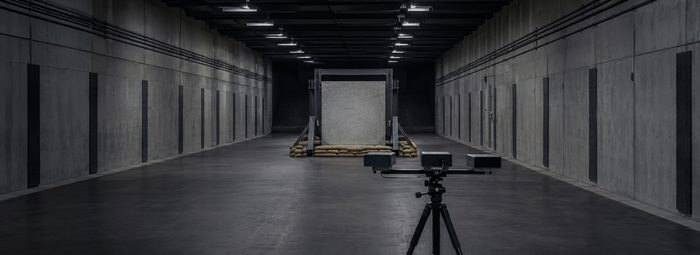
How an engagement runs
From Requirement to Submittal
Every program follows the same five stages, whether it is a single panel validation or a full building system.
- 1
Define
Requirement, threat profile and the standard you have to meet.
- 2
Model
Ballistic, blast and EMP response modeled before anything is cast.
- 3
Formulate
Mix design, particle packing, admixture and fiber configuration.
- 4
Test
Live fire and laboratory testing to UL‑752, NIJ and DoD criteria.
- 5
Report
Documentation packaged for your submittal and approval chain.
Capability
What We Can Model and Test
Four domains, tested against the standards your specification is written to.
Ballistic
- UL-752 levels and spall
- NIJ threat profiles
- Spall and ricochet characterisation
- Full-scale mockups
Blast
- Blast pressure response
- Standoff modeling
- Fragment and debris behavior
- Hostile vehicle impact
EMP / RF
- TEMPEST
- MIL-STD-188-125
- Shielding effectiveness
- Conductive embed integration
Structural
- Compressive strength
- Particle packing optimization
- Admixture chemistry and fibers
- Durability and thermal shock
Securing a Facility, a Safe Room, or a Perimeter?
Tell us what you’re protecting and we’ll tell you which material fits, what it costs, and how it installs.
Talk to Amidon