
Perimeter & Access Security
Move ballistic protection
to where it is needed.
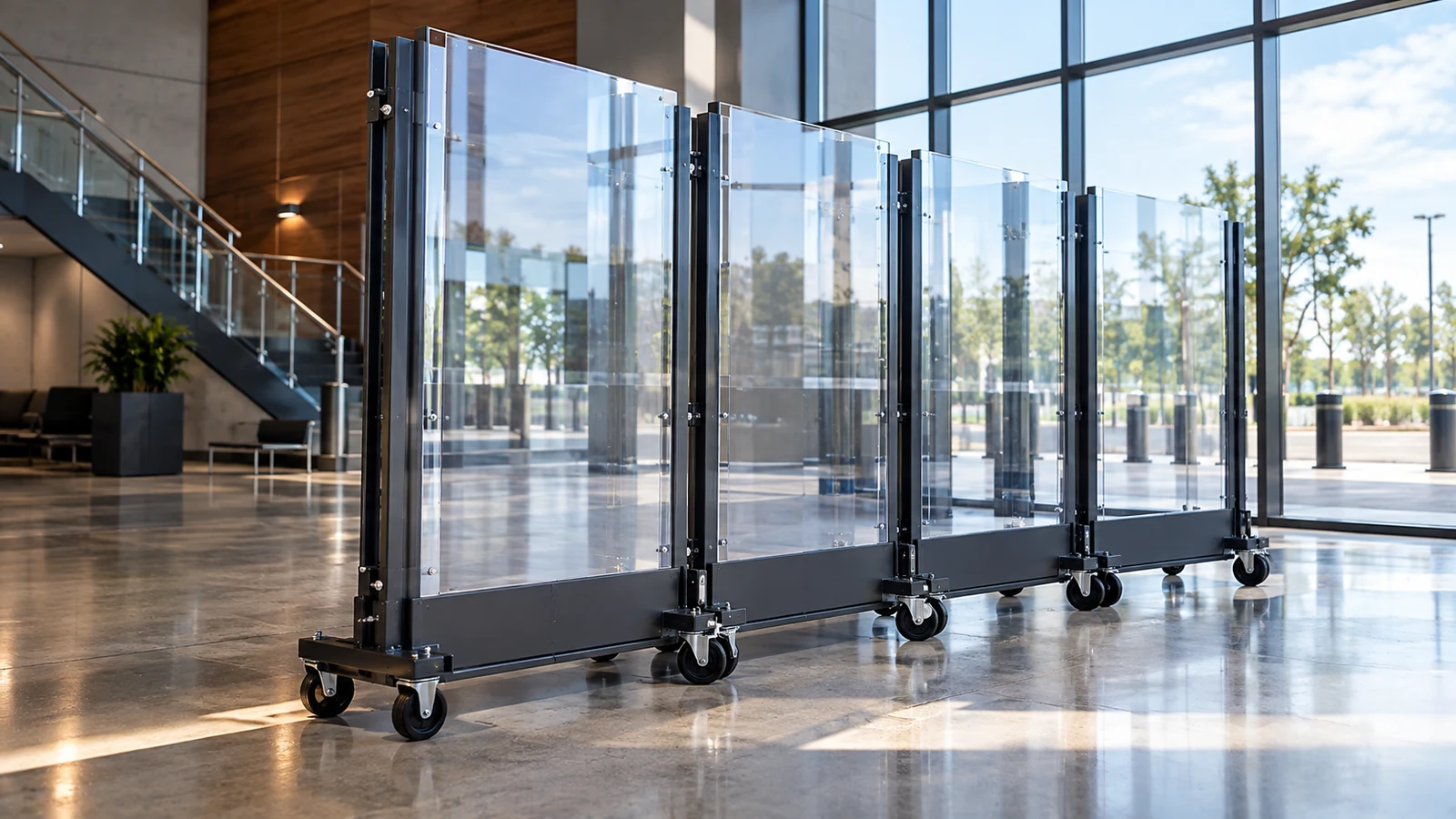
Wheeled transparent ballistic panels that link together into a movable security wall and come apart again. For the protected position that does not stay in one place. Manufactured in North Carolina.
A different problem
A wall protects a boundary. This protects a position.
Hardened construction is the right answer when the line you are defending is fixed and known. A great many protected positions are neither.
A negotiation point sets up where the subject is. A screening line moves when the entrance changes. A reception desk needs cover on a Tuesday and the lobby back on Wednesday. A tactical team needs a shield wall at an address that was chosen by somebody else an hour ago. None of those is a construction problem, and treating them as one produces either a permanent wall in the wrong place or no protection at all.
Transparent panels solve the movable case. Knowing which case you actually have is the part worth getting right, and it is the first question Amidon asks.
System overview
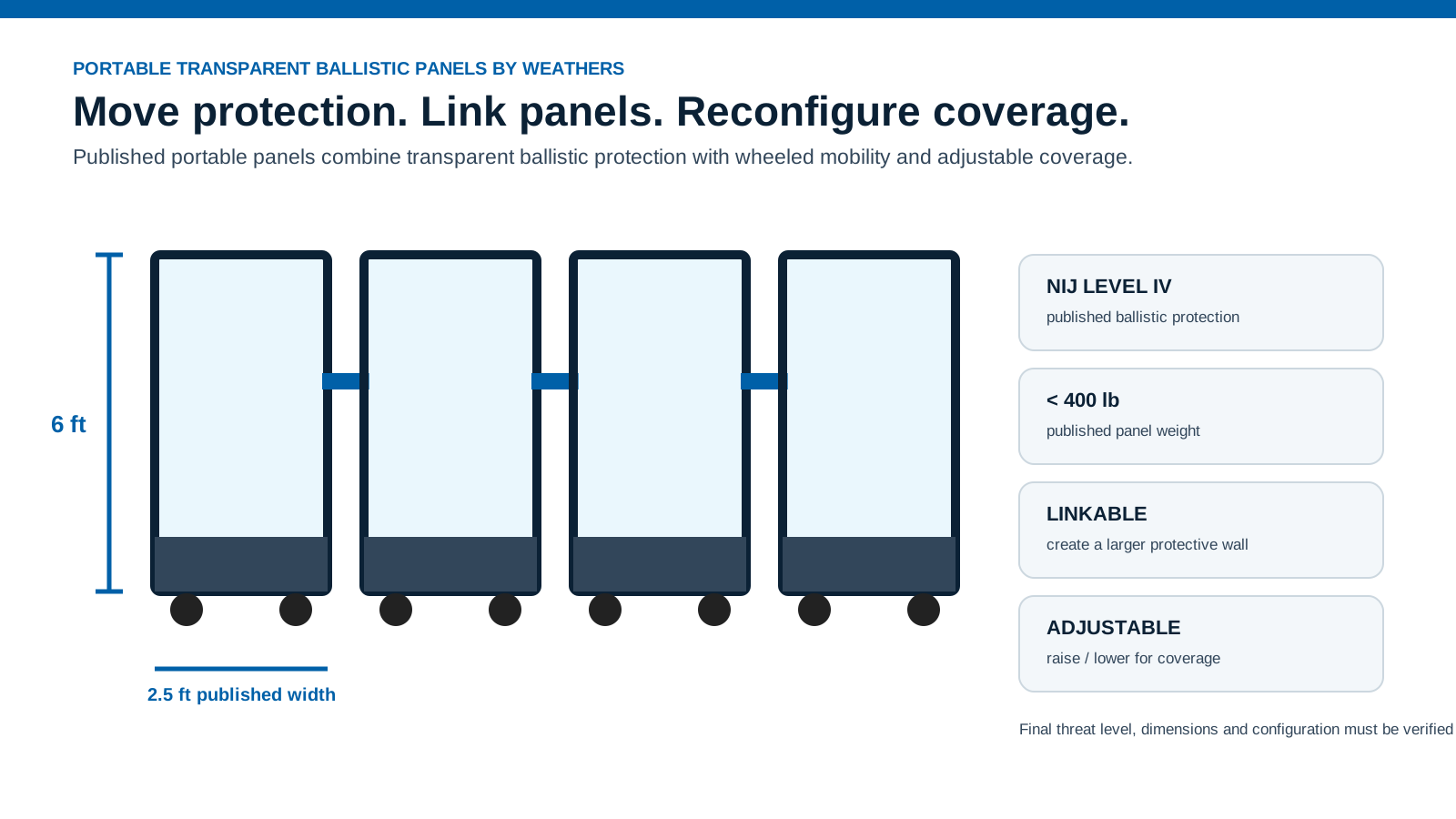
Published reference configuration.
Dimensions and weight matter more here than on any other product in this line, because a panel nobody can move is a wall with wheels on it.
| Characteristic | Published | Why it matters |
|---|---|---|
| Height | 6 ft | Standing coverage for the protected person |
| Width | approx. 2.5 ft | Sets how many units a given frontage requires |
| Weight | under 400 lb | Movable by the team that owns it, on wheels, without equipment |
| Adjustment | — | Hydraulic and hand-powered controls to raise, lower and set coverage |
| Optical quality | — | Low-iron, high-clarity glazing — the protected person has to be able to see and be seen |
| Configuration | — | Wheeled units, linkable into a larger bullet-resistant wall |
Published reference figures for the standard configuration. Ballistic level is configuration-specific; Amidon obtains current test documentation for the exact quoted configuration before a level-specific requirement is quoted.
Reading the standard
This product is published to NIJ. The rest of this site speaks UL 752.
Both are legitimate ballistic standards. They are not two scales of the same thing, and a level in one does not convert to a level in the other.
| NIJ 0108 / 0101 levels | UL 752 levels | |
|---|---|---|
| Written for | Body armor and ballistic-resistant protective materials | Bullet-resisting equipment in buildings — glazing, doors, barriers |
| Typical use | Law enforcement and tactical equipment procurement | Architectural and facility specifications |
| How the levels work | Levels are threat definitions, not a difficulty ladder. Level IV addresses a rifle threat. | Levels are threat definitions tied to specific round designations. Also not a ladder. |
| Cross-reference | There is no official conversion table. A requirement written in one standard is satisfied by test documentation in that standard, not by an equivalence argument. | |
If your specification is written to UL 752 and this product is published to NIJ, that gap is a procurement issue to resolve before award, not after. Amidon will tell you plainly when a product does not answer the standard you have written, and what does.
Where the line ends
This is not a substitute for a wall.
Portable panels give you coverage where you put them, for as long as somebody keeps putting them there. That is their strength and it is also the whole limitation.
They do not protect an unattended boundary. They do not protect a building overnight. They do not close a corridor, harden a safe room or carry a structural load. A panel line left in place permanently is a fixed ballistic wall built the most expensive possible way, and a fixed wall wheeled out to a scene is not going to arrive.
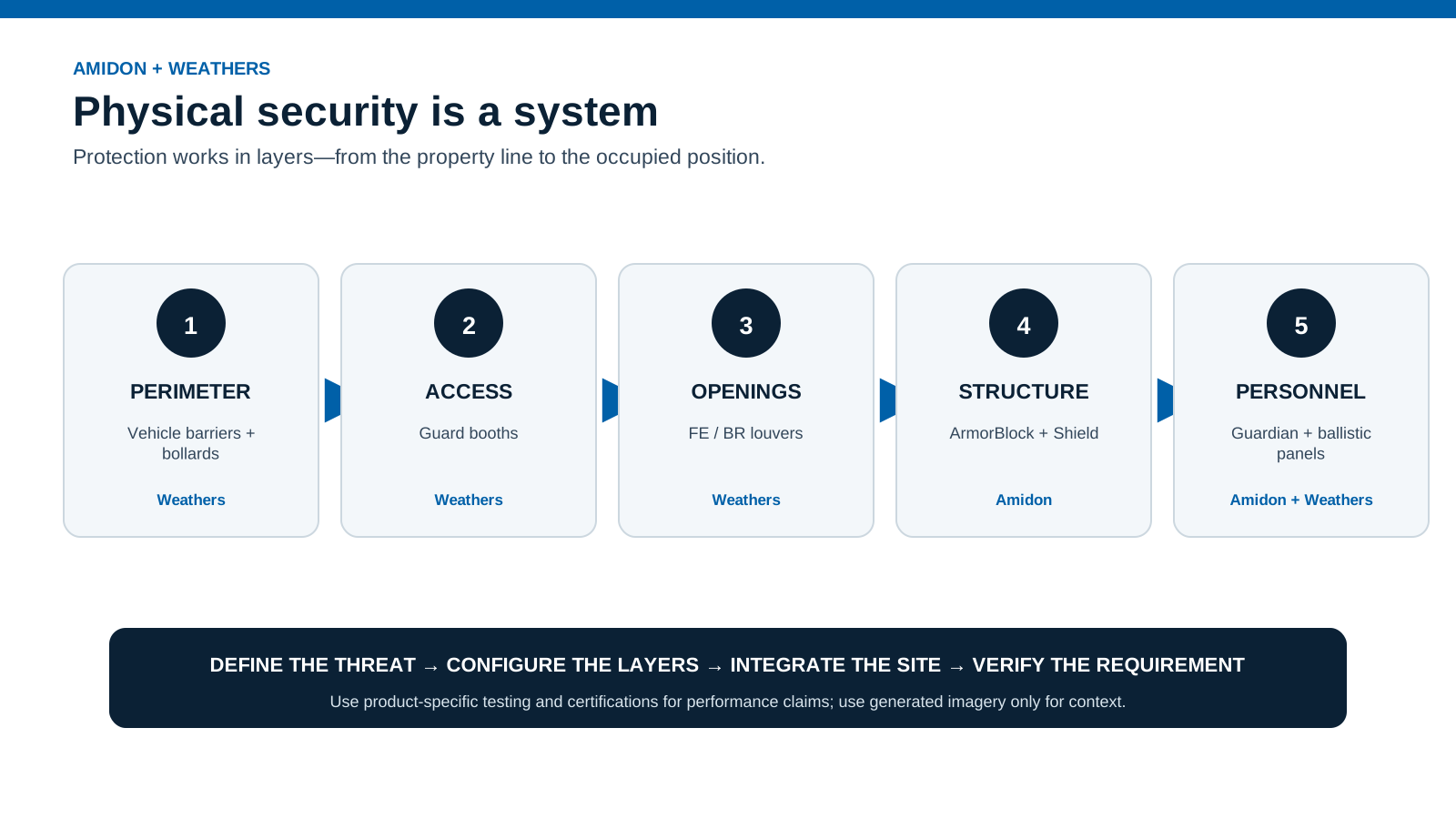
When the boundary is fixed, build it fixed — ArmorBlock for hardened walls and safe rooms, Amidon Shield where the structure itself has to absorb the threat, ballistic fiberglass for retrofit into existing construction. Most real programs need some of each, and we would rather scope that honestly than sell the wrong one.
From product to protected position
Four steps, in this order, every time.
- 1
Define
Threat basis, who is being protected, how often the position moves, required frontage, sightline requirements and the standard the specification is written to.
- 2
Configure
Panel count for the frontage, ballistic level, adjustment method, and whether the requirement is genuinely mobile or a fixed assembly in disguise.
- 3
Integrate
Coordinate with fixed protection already in place, storage and transport between deployments, and the team that has to move them under pressure.
- 4
Field
Delivery, familiarization, documentation and the test evidence supporting the specified level, confirmed before the panels are relied on.
Where it fits
Built for protected positions that do not stay put.
- Law-enforcement operations
- Hostage and crisis negotiation teams
- Tactical and SWAT deployments
- Security checkpoints and screening lines
- Public buildings and civic facilities
- Schools and houses of worship
- Temporary protected positions
- High-risk reception and intake areas
Government & institutional procurement
Build a project configuration — not a shopping cart.
Public product literature is useful for screening a solution. It is not a submittal package, and it is not a basis for award.
Standard matched first
Before anything else, we check that the standard your specification is written to is the standard the product is documented against. That mismatch is the most common way a ballistic procurement goes wrong.
Domestic manufacture
These panels are manufactured in North Carolina. Domestic-preference and trade-agreement determinations are confirmed against the terms of the specific solicitation.
Documentation to the configuration
Current test evidence for the exact quoted configuration, issued with the quotation rather than promised after award.
Honest fit assessment
If the requirement is really a fixed wall, we will say so and quote the fixed wall. A mobile product sold into a permanent requirement fails the customer twice.
Program questions
What to settle before ordering.
Are these a replacement for a permanent ballistic wall?
Usually not. They solve a different problem — mobile or reconfigurable coverage. A permanent boundary is better and more cheaply served by purpose-built ballistic construction: ArmorBlock, Amidon Shield, or ballistic fiberglass retrofitted into existing walls.
Can panels be linked together?
Yes. The system is published as linkable, so multiple wheeled units form a larger bullet-resistant line. How many you need is a function of the frontage you have to cover, which is worth calculating before ordering rather than after.
What level of protection is published?
The portable transparent shield literature identifies NIJ Level IV. Before quoting against a level-specific requirement, Amidon obtains the current supporting documentation for the specific configuration — and checks that NIJ is the standard your specification actually asks for.
Our spec is written to UL 752. Does Level IV satisfy it?
Not automatically, and we will not tell you it does. NIJ and UL 752 are separate test regimes with no official conversion. If your specification requires UL 752, the resolution is either test documentation in that standard or a specification amendment — settled before award, in writing.
Can Amidon help decide between mobile and permanent?
Yes, and it is the most useful thing we do on this product. Start with the threat, the protected position, how often it actually moves, sightline requirements and the operating environment. The answer is frequently some of each.
Who manufactures these?
Amidon supplies and integrates portable ballistic panels built by a manufacturing partner in North Carolina. Your submittal package carries that manufacturer’s own test report for the exact configuration quoted, with the report number on it — which is a stronger document than a supplier’s restatement of someone else’s results. Manufacturer identity and current cut sheets are issued with the quotation.
Tell us who has to be protected — and whether the position moves.
Give us the threat basis, the frontage, how often it relocates and the standard your specification is written to. We will tell you whether this is the right product before we quote it.
Discuss a panel requirement