
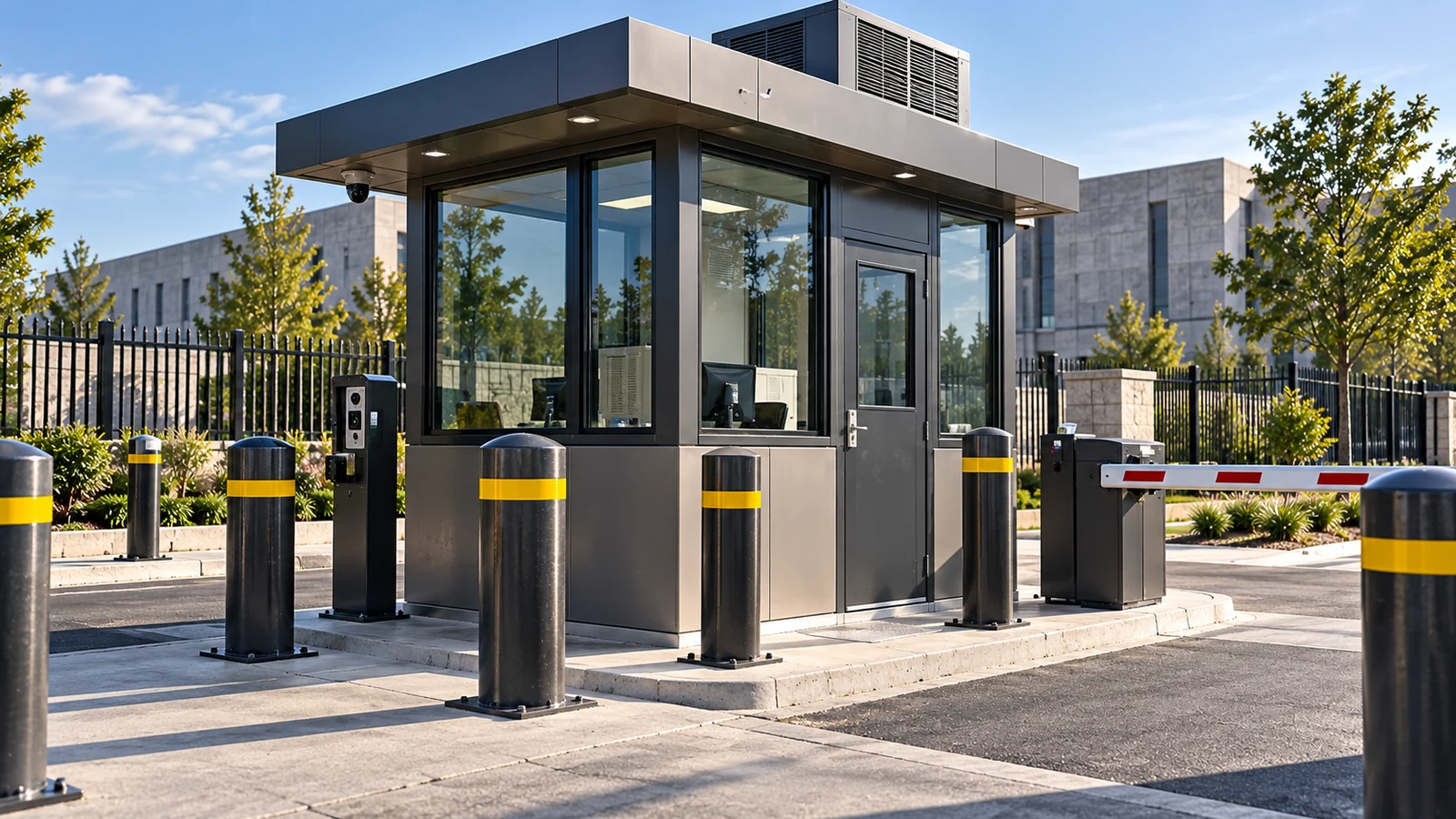
Perimeter & Access Security
Protect the person
controlling the perimeter.
A preassembled, climate-controlled security position built around the officer who inspects vehicles, checks credentials and decides who comes through. Manufactured in North Carolina.
What makes this different
It is the only thing on the perimeter with a person inside it.
Every other product in this line is an assembly that resists a threat. A guard booth has to resist a threat and simultaneously be a workplace for twelve hours at a stretch.
That doubles the engineering. The ballistic envelope has to stop the round; the glazing that stops it also has to let the officer read a badge at arm's length and watch the lane behind the vehicle. The structure has to carry the protection; it also has to carry an HVAC unit, a load center, lighting, cameras, an intercom and a pass-through drawer. And it has to be comfortable enough in a Carolina August that nobody props the door open, because a propped door defeats every test result on the submittal.
A booth specified only as a ballistic assembly usually fails on the second half. Amidon specifies both.
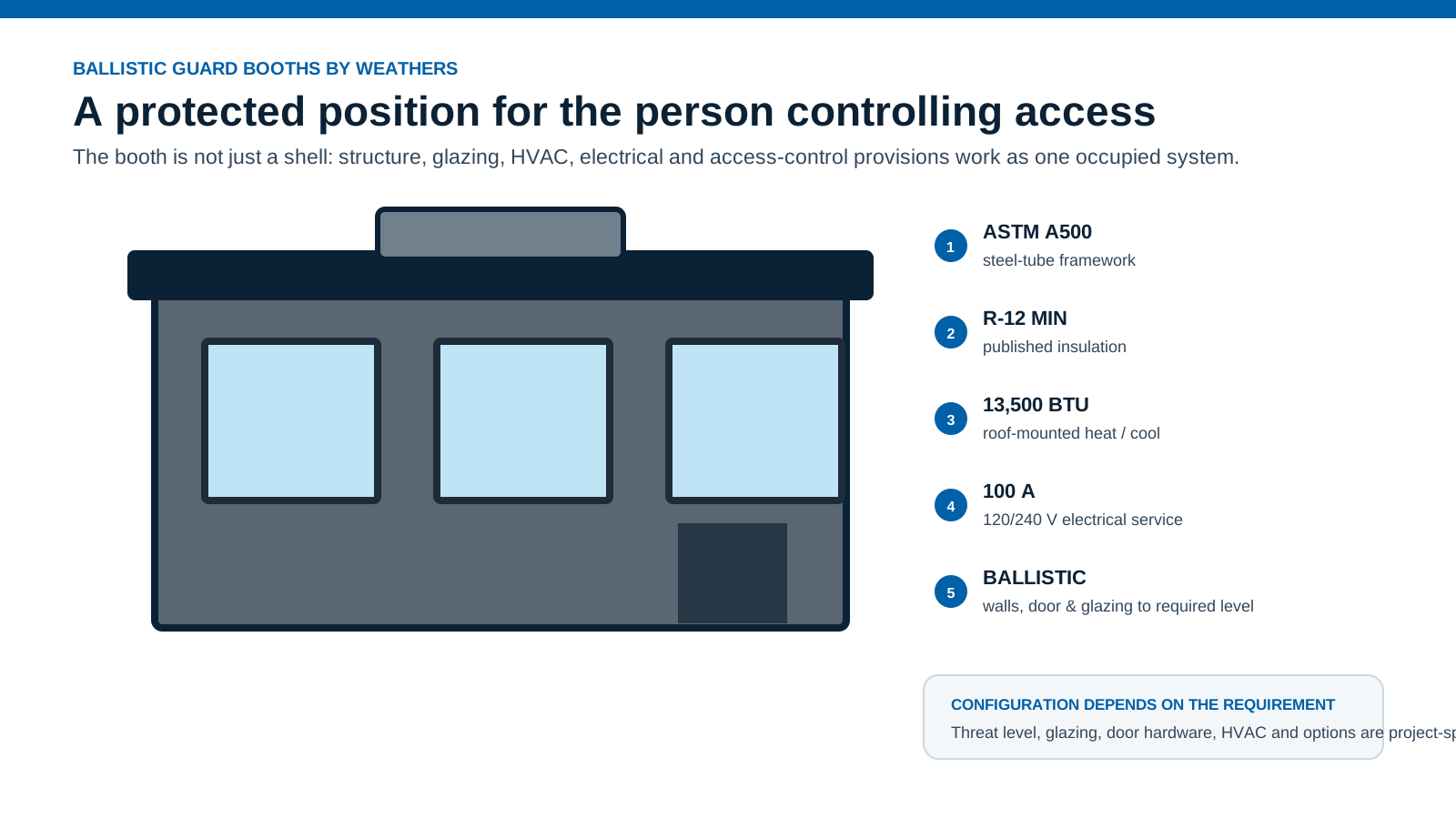
Published standard configuration
What arrives before a single option is added.
The booth is prefabricated and delivered as a unit. These are the published baseline characteristics; ballistic protection and access-control equipment are configured on top of them.
| Element | Published standard |
|---|---|
| Structural framing | Steel mechanical square tube meeting ASTM A500 |
| Prefabrication standard | Built to UFGS Section 13 34 21 |
| Thermal envelope | Minimum R-12 insulation |
| Climate control | 13,500 BTU roof-mounted heating and cooling unit |
| Electrical | Factory-prewired, minimum 100 A 120/240 V single-phase load center |
| Ballistic options | Exterior walls, door and glazing to the required level; bullet-resistant HVAC shroud available |
Figures describe the published standard configuration. Ballistic level, glazing, door assemblies and options are configuration-specific; Amidon confirms tested assemblies for the exact quoted booth against current manufacturer documentation before submittal.
Sightlines first
Glazing layout is driven by what the officer has to see — approaching vehicle, driver's hands, plate, and the lane behind — before it is driven by the ballistic level.
Transaction hardware
Pass-through compartments, gun ports, through-window communication, keypad hardware and exterior lighting specified to how the post actually operates.
Data and control
Cameras, Ethernet and custom wiring, shelving and cabinets integrated at build rather than retrofitted into a finished ballistic envelope.
Set and connect
Delivered preassembled. Site scope is the pad, the service connection and the anchorage — not a construction program at a live gate.
Where the line ends
A booth protects the officer. It does not protect the gate.
Ballistic glazing stops a round aimed at the person inside. It does nothing about the vehicle that never slows down.
At an access-control point those are two separate threats arriving on two separate vectors, and each needs its own answer. The booth handles the first. The barrier line and the bollards handle the second. The wall behind the booth handles what gets past both. A gate hardened against only one of the three has a tested component and an untested outcome.
Specifying the booth in isolation is how that happens. Amidon scopes the whole access-control point against one threat basis — which is the only way the test results on the submittal add up to protection on the ground.
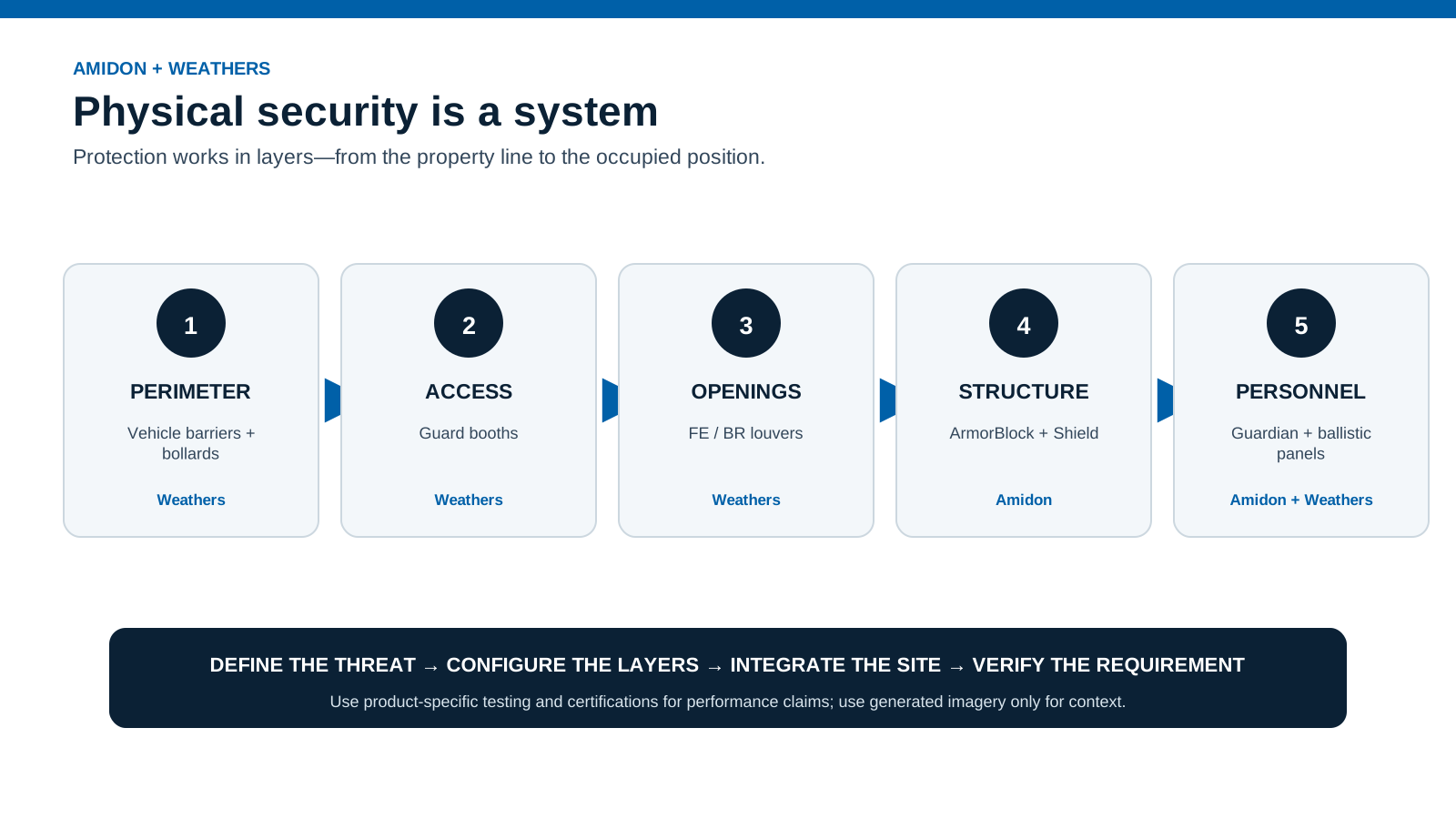
From product to protected site
Four steps, in this order, every time.
- 1
Define
Threat basis, post duties, hours of occupancy, sightline requirements, traffic volume, site conditions and the standard the specification has to satisfy.
- 2
Configure
Ballistic level, glazing and door assemblies, transaction hardware, communications, electrical load and climate capacity matched to the post.
- 3
Integrate
Coordinate with the barrier, bollards, lane geometry, access control, site power and data, and the hardened structure behind the gate.
- 4
Field
Pad and anchorage, delivery and set, service connection, commissioning and close-out documentation confirmed before the post is manned.
Where it fits
Built for gates that are staffed, and staffed gates that matter.
- Military and government installation gates
- Data center and network facility entrances
- Utility, generation and energy sites
- Industrial and manufacturing campuses
- Ports and transportation facilities
- Critical infrastructure checkpoints
- Secure commercial campuses
- Controlled parking and service entrances
Government & institutional procurement
Build a project configuration — not a shopping cart.
Public product literature is useful for screening a solution. It is not a submittal package, and it is not a basis for award.
Scoped before quotation
Threat basis, quantity, ballistic level, glazing and door assemblies, options, site requirements, delivery, set responsibility and documentation — settled before a number is issued.
Domestic manufacture
These booths are manufactured in North Carolina. Domestic-preference and trade-agreement determinations are confirmed against the terms of the specific solicitation.
Documentation to the assembly
Tested assemblies for the specified ballistic level, not a family-level claim, issued with the quotation.
The whole gate
Booth, barrier, bollards and the structure behind them specified against one threat basis, coordinated on one drawing set.
Program questions
What to settle before ordering.
Is the ballistic level fixed?
No. Ballistic walls, door and glazing are configured to the level the project requires. The threat level and the specific tested assemblies are confirmed for the project — a booth is an assembly of tested components, and the result that matters is the one for the assembly as built.
What operating equipment can be integrated?
Published options include transaction and pass-through compartments, gun ports, keypad hardware, cameras, Ethernet and custom wiring, exterior lighting, through-window communications, shelving and cabinets. Specifying them at build is materially cheaper and cleaner than cutting into a finished ballistic envelope later.
Is HVAC included?
The published standard configuration lists a 13,500 BTU roof-mounted heating and cooling unit. A bullet-resistant enclosure for the unit is available on ballistic models — worth specifying, since a roof unit is otherwise an unprotected penetration in an otherwise hardened envelope.
What site work do we have to do?
Typically a pad, anchorage and a service connection. The booth arrives preassembled, which is the point — it avoids running a construction program at a gate that still has to pass traffic.
Can Amidon coordinate the whole gate?
Yes, and the booth is strongest that way. A coordinated access-control point addresses the barrier, bollards, fencing, lane geometry, the booth and the protected facility together. Piecemeal procurement is what produces gates where each part is tested and the entrance is not.
Who manufactures these?
Amidon supplies and integrates guard booths built by a manufacturing partner in North Carolina. Your submittal package carries that manufacturer’s own test report for the exact configuration quoted, with the report number on it — which is a stronger document than a supplier’s restatement of someone else’s results. Manufacturer identity and current cut sheets are issued with the quotation.
Tell us what the post has to do — and what it has to survive.
Give us the duties, the hours, the threat basis and the site. We will come back with a booth configured for the officer who works in it and the entrance it sits on.
Configure a guard booth