
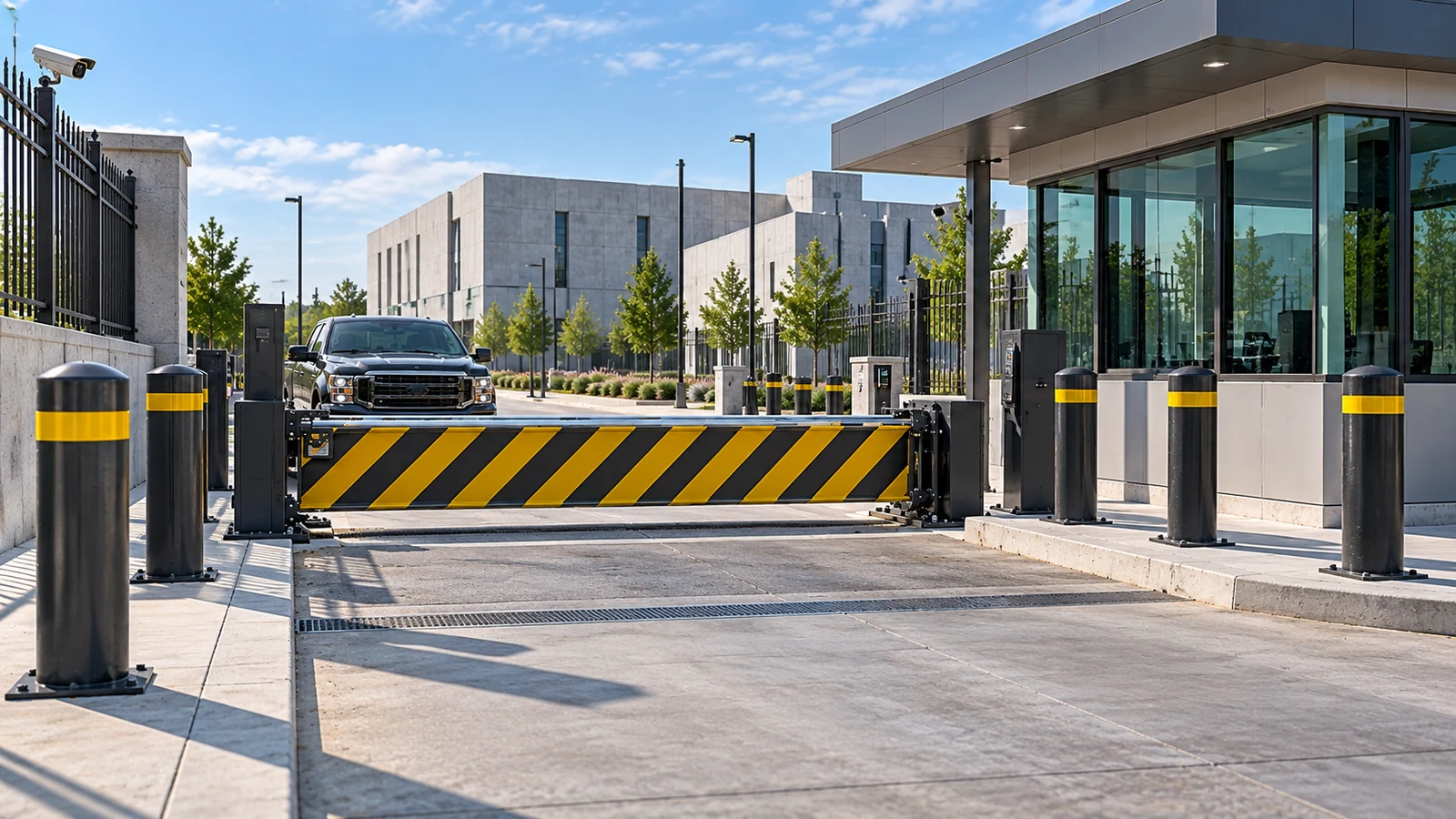
Perimeter & Access Security
Control the approach before
the threat reaches the building.
Active vehicle denial at the access-control point — specified from the threat vehicle and the approach it has to run, not from a catalog page. Manufactured in North Carolina.
The integration problem
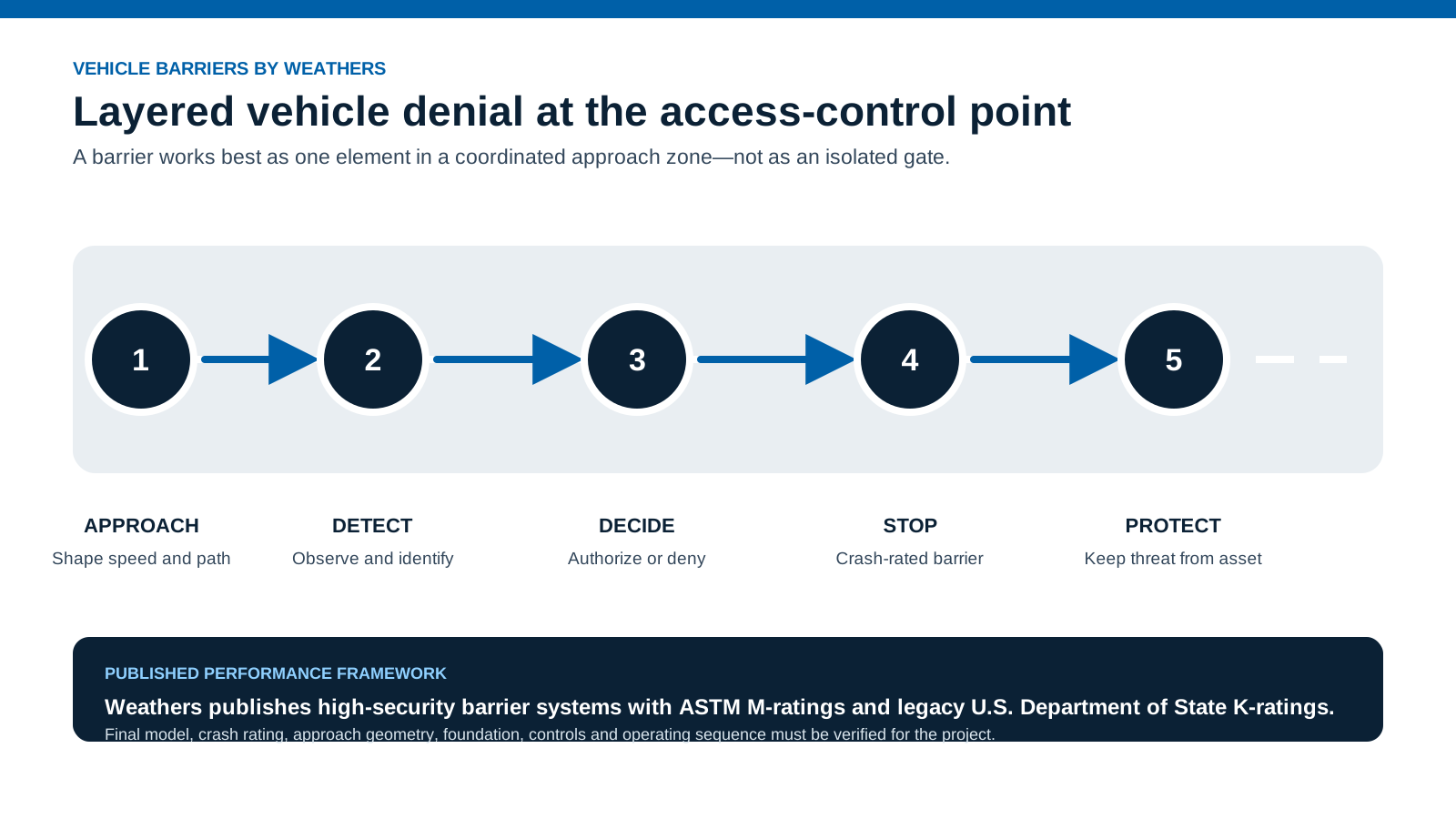
The barrier stops the vehicle. The approach decides whether it gets the chance.
A crash-rated barrier is not a gate with a certificate. Its value is set by conditions that exist fifty, a hundred, three hundred feet before it.
Approach speed is a function of lane geometry, not of the barrier. A vehicle that cannot reach 50 mph because the approach turns twice does not need an M50 barrier; a vehicle with a quarter mile of straight run at an unprotected lobby needs more than one. Standoff between the barrier and the protected face determines whether a P1 penetration limit is required or whether P2 is adequate. Cycle rate determines whether the barrier can keep up with the traffic the site actually carries, and a barrier that cannot keep up gets propped open.
Those are site questions. Amidon answers them and then specifies the hardware, rather than the other way round.
Selection drivers
Eight inputs decide the barrier. The crash test is one of them.
A specification that names only a threat level leaves seven decisions to whoever quotes it. These are the questions Amidon settles before a configuration is proposed.
| Input | What it decides |
|---|---|
| Threat vehicle mass | The M-designation the barrier is tested against, and the foundation behind it |
| Achievable approach speed | Whether M30, M40 or M50 is the honest requirement for this geometry |
| Available standoff | The penetration limit — P1, P2 or P3 — the site can tolerate |
| Clear opening width | Barrier type and the operating mechanism available at that span |
| Cycle rate and duty | Whether the system sustains the site's real traffic without being defeated by its own operators |
| Operating mode | Normal, degraded and emergency behavior, and what happens on loss of power |
| Foundation conditions | Excavation depth, utility conflicts, and whether a shallow system is required |
| What stands behind it | Whether the barrier is the protection or only the first layer of it |
Performance is model-specific. Amidon confirms the tested basis for the exact quoted configuration against current manufacturer documentation before submittal. Domestic-preference and trade-agreement determinations are made against the terms of the individual solicitation.
A common specification error
A barrier is not a gate. Most entrances need both.
A gate controls who comes in. A barrier stops a vehicle that has decided not to ask. They are different products solving different problems, and one does not substitute for the other.
A gate built for wind load and a thousand cycles a day will not stop fifteen thousand pounds at forty miles an hour. A crash barrier operating on every routine delivery wears out and frustrates the guard force until someone leaves it down. The working answer at most secure entrances is both: a security gate or barrier arm gate that runs the traffic, and a crash barrier that holds the line, sequenced so that neither one is doing the other's job.
Behind both sits the question of what the vehicle would have reached. That is where Amidon's own material goes in — the hardened wall, the protected lobby, the equipment enclosure — specified against the same threat basis as the barrier in front of it.
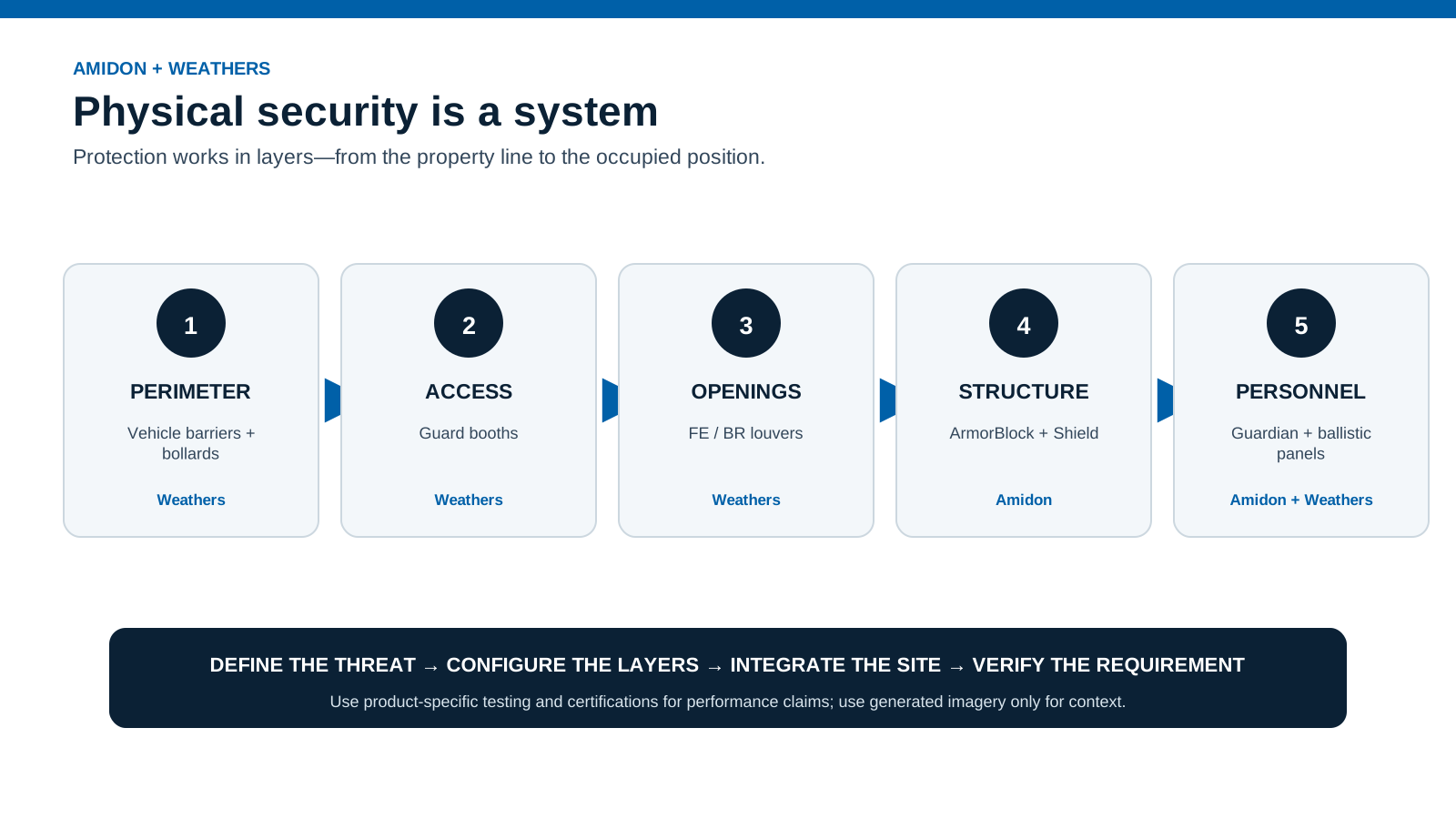
From product to protected site
Four steps, in this order, every time.
- 1
Define
Threat vehicle, achievable approach speed, standoff, opening width, traffic volume, operating sequence and the standard the specification has to satisfy.
- 2
Configure
Barrier type, threat basis, operating mode, controls and foundation matched to the site rather than selected from a product family.
- 3
Integrate
Coordinate with the guard position, bollard line, fencing, lane geometry, access control, utilities and the hardened structure behind the entrance.
- 4
Field
Submittals, delivery, installation responsibility, commissioning, operator familiarization and close-out documentation settled before the system carries traffic.
Where it fits
Built for entrances where a vehicle getting through is the event you are preventing.
- Military installations and base access points
- Government and diplomatic campuses
- Data centers and AI infrastructure
- Utility and power generation facilities
- Battery energy storage sites
- Industrial and chemical facilities
- Ports and transportation infrastructure
- Secure corporate campuses
Government & institutional procurement
Build a project configuration — not a shopping cart.
Public product literature is useful for screening a solution. It is not a submittal package, and it is not a basis for award.
Scoped before quotation
Threat basis, quantity, exact configuration, controls, accessories, site requirements, delivery, installation responsibility and documentation — settled before a number is issued.
Domestic manufacture
These barriers are manufactured in North Carolina. Domestic-preference and trade-agreement determinations are confirmed against the terms of the specific solicitation.
Documentation to the model
Current cut sheet and test report for the exact quoted configuration, issued with the quotation rather than after award.
One responsible party
Amidon carries the entrance as a system — barrier, bollards, guard position and the structure behind them — from requirement through commissioning.
Program questions
What to settle before ordering.
Is every barrier tested to the same basis?
No. The tested basis is specific to the model and its installation detail. Two barriers from the same product family can carry different ones. The exact model and its current test documentation are confirmed for the project before quotation.
Does the crash test alone determine the correct barrier?
No, and this is the most common specification error we see. Threat vehicle, achievable impact velocity, allowable penetration, approach geometry, clear opening width, cycle rate, operating sequence, utilities and foundation conditions all change the answer. A threat level quoted with none of that context describes a test, not a requirement.
Can the barrier be designed as part of a complete entrance?
That is the preferred approach. Barrier, guard position, bollard line, fencing, lane geometry and the protected facility are treated as one access-control system specified against a single threat basis. Buying them separately is how entrances end up with a tested barrier and an untested wall twenty feet behind it.
What happens on loss of power?
That is a design decision, not a product property, and it should be made deliberately. Fail-secure, fail-safe and manual-override behavior are specified against the site's emergency procedures — including how fire apparatus gets in.
Who manufactures these?
Amidon supplies and integrates vehicle barriers built by a manufacturing partner in North Carolina. Your submittal package carries that manufacturer’s own test report for the exact configuration quoted, with the report number on it — which is a stronger document than a supplier’s restatement of someone else’s results. Manufacturer identity and current cut sheets are issued with the quotation.
Tell us what has to be protected — and what the entrance has to keep doing.
Give us the threat basis, the approach, the traffic the gate actually carries and the delivery location. We will come back with a configuration that meets the standard and survives daily use.
Discuss a barrier requirement