
Amidon Labs
Independent Testing and Test Data
What was tested, who tested it, and what it recorded. Every result below belongs to the named material or assembly, tested under the stated conditions.
Ballistic · Amidon Shield block
UL 752 Level 10 threat, no penetration
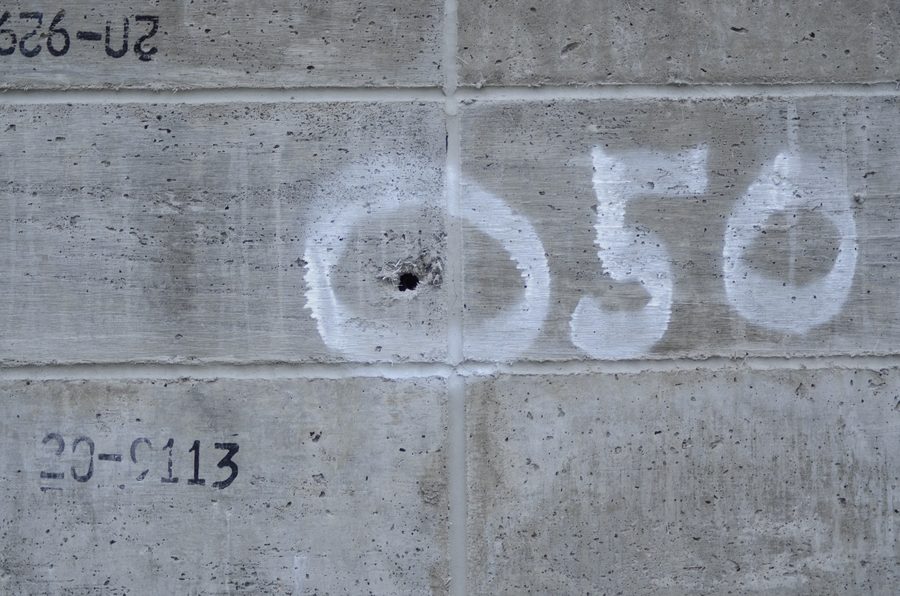
An eight-inch Amidon Shield block was independently tested by NTS-Chesapeake Testing under UL 752 and NIJ-STD-0108.01 protocols at zero degrees obliquity. It defeated the UL 752 Level 10 threat, a .50 caliber 710-grain M2 Ball round at 2,967 ft/s, with no penetration, along with the UL 752 Level 7 and Level 8 threats, the supplementary shotgun threat, and the NIJ Level IIIA and Level III threats.
- UL 752 Level 10 (.50 caliber). 710-grain M2 Ball, one shot at 2,967 ft/s, no penetration.
- UL 752 Level 8 (7.62 mm). 150-grain M80 FMJ, five shots at 2,802 to 2,849 ft/s, no penetration.
- UL 752 Level 7 (5.56 mm). 55-grain M193 Ball, five shots at 3,290 to 3,317 ft/s, no penetration.
- UL 752 supplementary shotgun. 12-gauge 1-ounce slug, three shots, no penetration.
- NIJ-STD-0108.01 Level IIIA and Level III. .44 Magnum 240-grain and 7.62x51mm 149-grain M80, five shots each, no penetration.
NTS-Chesapeake Testing, Belcamp, Maryland, November 2019. NTS states in its report that it has no affiliation with Amidon. Laboratory results are test results; they are not a UL certification, listing or rating.
Ballistic · conditioning
Cold, freeze-thaw and repeat fire
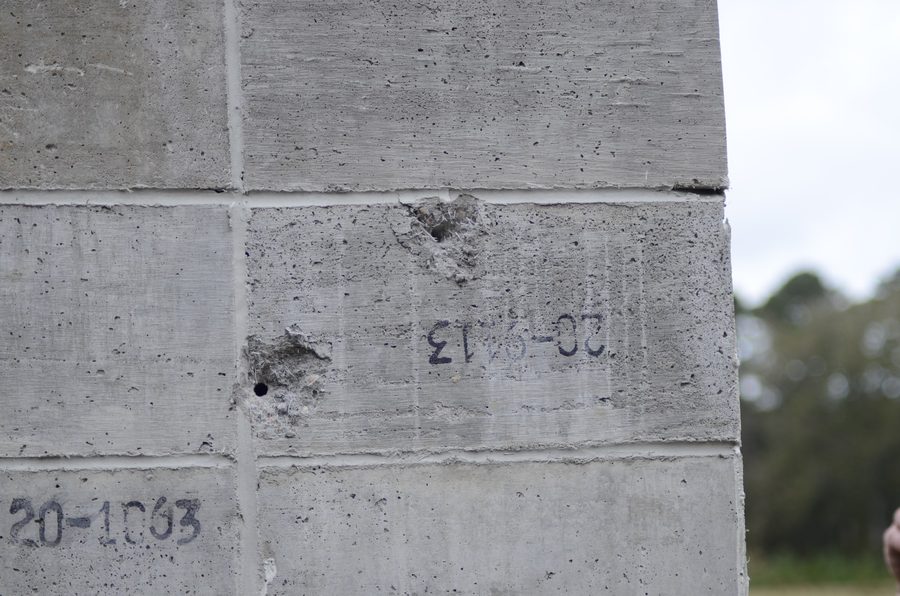
In ricochet testing at 15 degrees obliquity, 24 x 24 x 8 inch Amidon Shield panels were fired on at ambient temperature, after cold conditioning, and after freeze-thaw conditioning.
- Ambient. 22 consecutive 7.62x51mm M80 rounds absorbed, no penetration.
- Cold. A further 22 rounds after cold conditioning, no penetration.
- Freeze-thaw. 20 cycles per MIL-STD-810G Method 524 Procedure 1, held at minus 50 °F for 12 hours and tested on removal from the chamber: 22 consecutive M80 rounds, no penetration.
Across the three conditions, Amidon Shield panels absorbed 66 consecutive 7.62x51mm M80 rounds at 15 degrees obliquity with no penetration.
Ballistic · ArmorBlock wall system
.50 caliber stopped at three inches
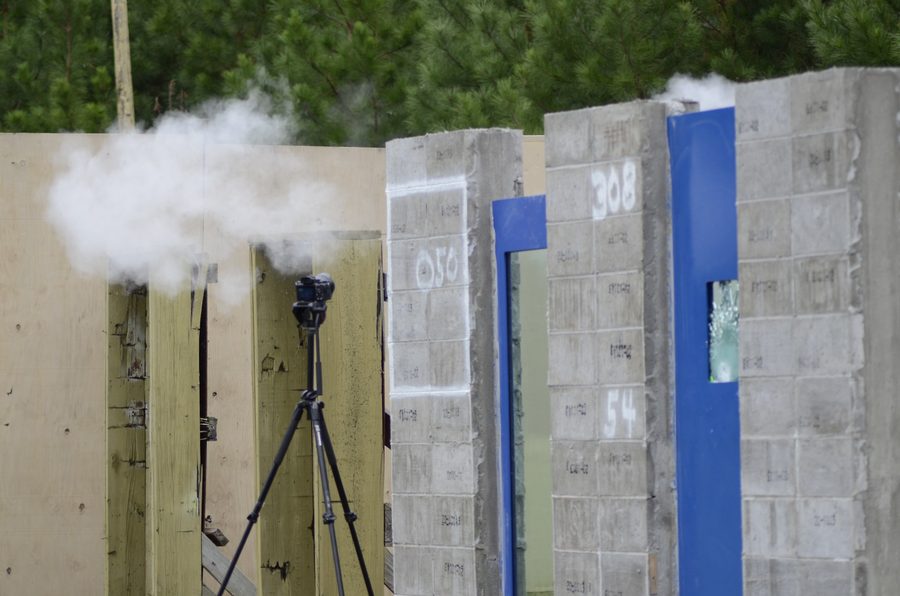
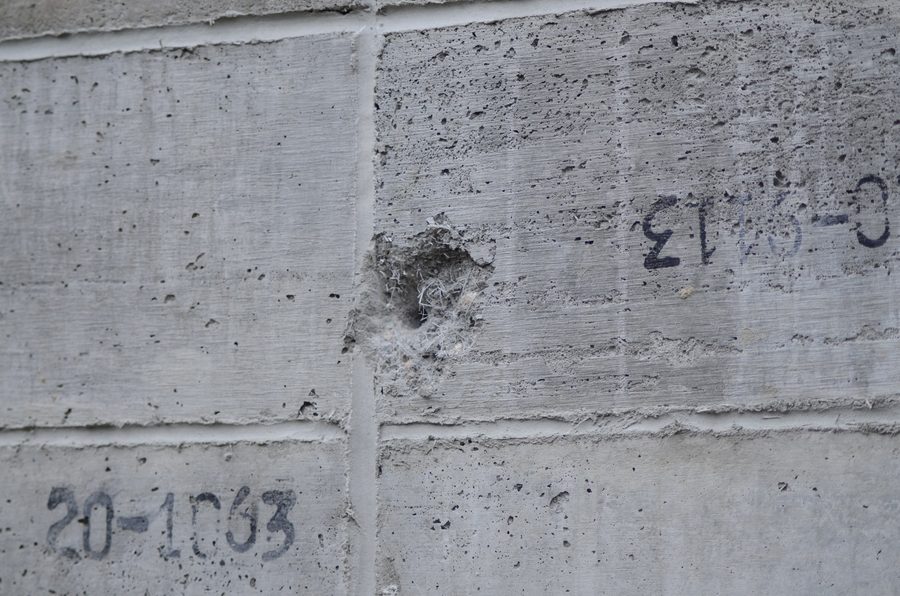
An eight-inch ArmorBlock wall with cells filled with 4,500 psi Amidon Shield and #4 rebar at 16 inches on center stopped a .50 caliber M33 660-grain full metal jacket round at 3 inches of penetration, with no spalling, cracking or deformation observed on the back face of the panel.
- 7.62x51mm M80. Stopped at 1.5 inches, no back-face damage.
- 5.56x45mm M855. Stopped at 1 inch, no back-face damage.
- Conditions. Panel water-saturated after heavy rain, 53 °F, 98-foot standoff, near zero obliquity.
Tested by BLUEline Contracting in February 2025 to the ballistic penetration protocol established by the U.S. Army Aberdeen Test Center. The result belongs to the wall assembly with Shield fill; it is not a result for an ArmorBlock unit alone.
Across programs, independent testing has fired more than 70,000 rounds against the Amidon family of products.
Material properties · SGS TEC Services
Strength and durability, measured
Amidon Shield mix verification was performed by SGS TEC Services, an ISO/IEC 17025 accredited laboratory accredited by AASHTO and the U.S. Army Corps of Engineers.
| Specified compressive strength, 28 days (ASTM C39) | 4,500 psi |
|---|---|
| Recorded compressive strength, 28 days (ASTM C39) | 5,880 psi |
| Recorded compressive strength, 365 days (ASTM C39) | 7,020 psi |
| Flexural strength, 28 days (ASTM C78) | 1,270 psi |
| Splitting tensile strength, 28 days (ASTM C496) | 560 psi |
| Freeze-thaw, 300 cycles (AASHTO T161) | Durability factor 100 |
| Drying shrinkage, 28 days air cure (ASTM C157) | −0.074% |
Amidon Shield is specified and sold at its 28-day strength. The higher figure at 365 days is the same material measured later in its service life.
Thermal · internal testing
Direct flame and thermal shock
In internal testing, a 1,480 °F flame applied to the face of an eight-inch ArmorBlock and Shield wall raised the temperature on the opposite face by one degree, from 74 to 75 °F, with no cracking or spalling. A Shield block heated above 1,500 °F and quenched in 38-degree water showed no cracking.
These are internal Amidon tests. No recognized fire-test standard was run, and they are not a fire-resistance rating.
Heritage material · Amidon Ballistic Concrete
Where the family started
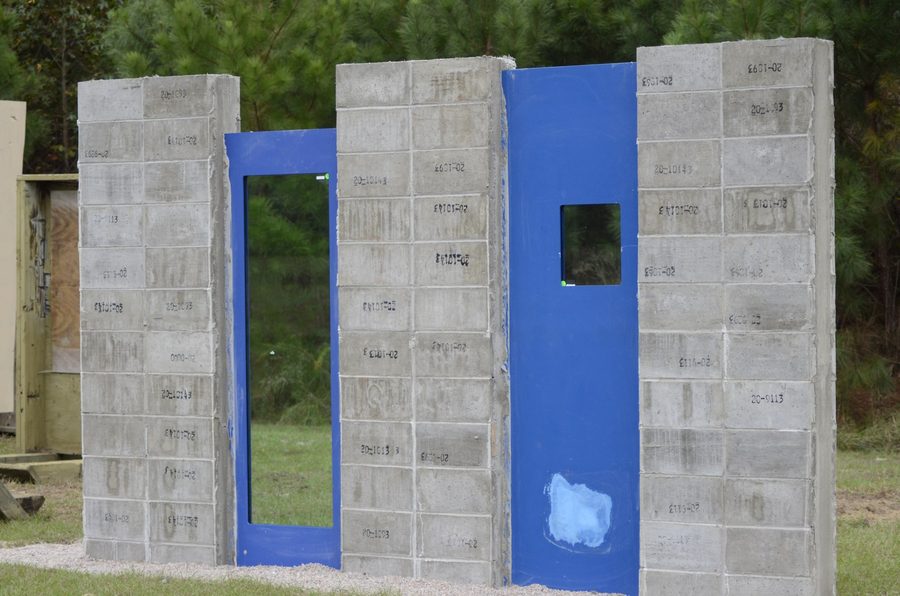
Amidon Ballistic Concrete (ABC) is the Amidon material engineered for live-fire training structures. Two independent programs on ABC are part of the family record. They are ABC results, not Amidon Shield results.
U.S. Army Aberdeen Test Center. In a program conducted for the U.S. Marine Corps (report ATC-11145, February 2013), ABC performed equal to SACON, the U.S. Army Corps of Engineers standard material for ballistic training construction.
- Core compressive strength, average
- ABC 1,923 psi · SACON 1,390 psi
- Core density, average
- ABC 92.3 lb/ft³ · SACON 88.5 lb/ft³
- Lead leaching · GHD, March 2020
- All Amidon concrete samples tested would pass the TCLP lead requirement and would not require special disposal.
In the GHD study, the untreated ABC control sample was the best performing of five samples, with no leachable lead detected and the lowest lead content in impact dust.
Aberdeen Test Center is cited as the testing authority for a result. Citation of a U.S. Army test report is not an endorsement; no U.S. Government agency endorses commercial products.
Test reports
Amidon materials have been tested independently by SGS TEC Services, NTS-Chesapeake Testing, GHD, Grace Analytical, BLUEline Contracting and the U.S. Army Aberdeen Test Center. Reports are shared with qualified project teams on request through your Amidon representative.
Securing a Facility, a Safe Room, or a Perimeter?
Tell us what you’re protecting and we’ll tell you which material fits, what it costs, and how it installs.
Talk to Amidon