Precast Amidon Shield
Factory-produced panels and protective components for perimeter walls and equipment screening. Repeatable sections, controlled production and erection planned around the construction sequence.

Applications
BESS security is not just the batteries. Amidon hardens the arrays, the power conversion equipment and the perimeter with protective concrete built three different ways.
Storage only earns its keep if the power is available when it is called for. The battery enclosures are one part of that. Power conversion systems, transformers, switchgear, controls and communications are all single points of failure sitting in the open on most sites.
Amidon works with owners, developers, utilities and EPC teams to bring those assets into one physical protection plan: harden the boundaries that matter, screen the equipment that cannot be replaced quickly, and do it without fighting the way the site has to be operated, maintained and expanded.
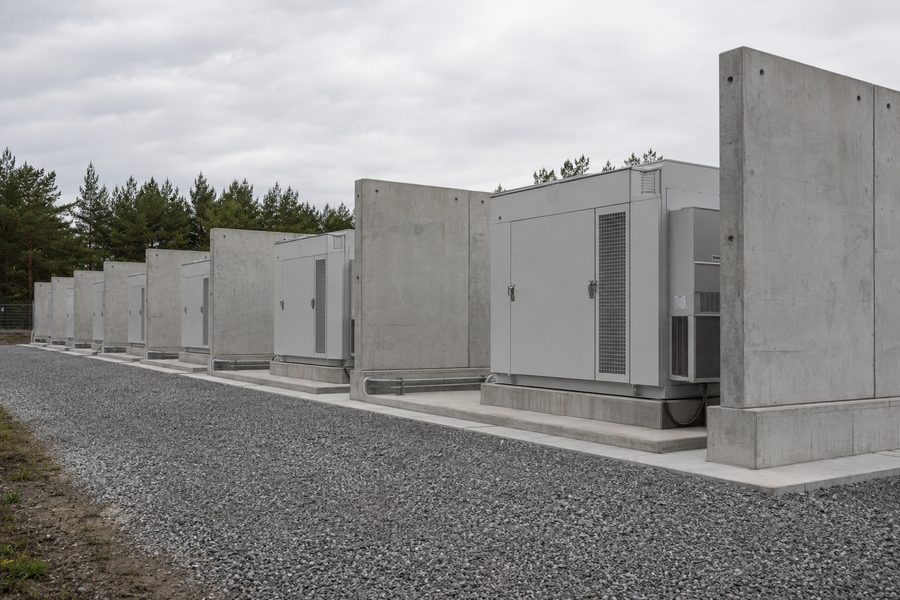
Match the construction format to the site, the contractor and the schedule.
Factory-produced panels and protective components for perimeter walls and equipment screening. Repeatable sections, controlled production and erection planned around the construction sequence.
Fillable masonry units with reinforcement and Amidon Shield fill. A practical route for protective walls, control spaces and retrofits, placed by ordinary masonry crews.
Field-placed construction and tailored components for irregular geometry, integrated wall layouts and projects where site-built work is the preferred approach.
Production and delivery are coordinated to the project through Amidon and its qualified producers, subject to format and availability. See the producer network.
Protection is worth specifying where a loss is expensive and slow to recover from. On a storage site that is rarely the whole fence line.
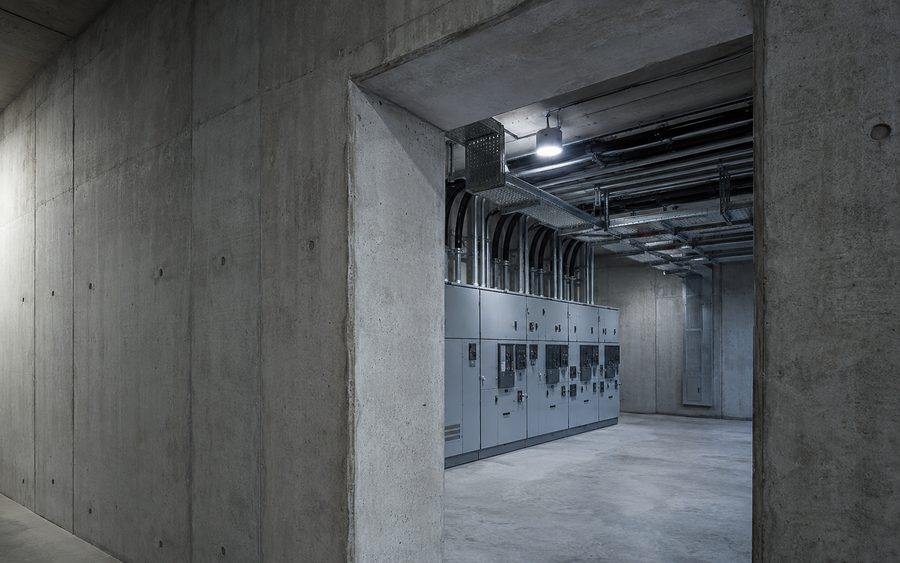
Amidon Shield came out of military and law enforcement live-fire environments, where walls are shot deliberately and repeatedly and still have to stand.
An eight-inch Amidon Shield block defeated the UL‑752 Level 10 threat, .50 caliber 710-grain M2 Ball, with no penetration. Amidon materials have captured more than 150 million rounds in service.
Round and detonation figures reflect Amidon’s broader historical portfolio.
That record is ballistic. It tells you what the material does when something hits it hard. Fire performance, blast performance and any separation distance are established for the specific assembly a project proposes, with the project's engineers.
Bring Amidon in while wall locations, access routes and equipment layouts can still move. After the layout is frozen, the options narrow and the cost goes up.
Protective material systems, and the work of applying them to walls, barriers and hardened spaces. That can include precast or cast-in-place Shield, ArmorBlock masonry, production coordination and installation support through qualified producers. Batteries, inverters and energy management software stay with the storage supplier.
Yes. Perimeter and equipment-area hardening can be evaluated for operating sites and for planned expansions. The design has to account for existing foundations and utilities, installation access, safe work limits, maintenance clearances and any outage window.
Where fire separation is in scope, Amidon works with the project's fire protection and structural engineers to evaluate a suitable assembly. The required fire performance has to be established for that assembly and that application. A ballistic result does not establish a fire-resistance rating and does not by itself justify a reduction in separation distance.
Start with the threat assessment, the storage layout and the protection objectives. The engineer defines the assembly from there: material, thickness, height, reinforcement, foundations, joints and openings. Test evidence has to correspond to the construction actually proposed.
NFPA 855 governs stationary energy storage installation. UL 9540A evaluates thermal runaway fire propagation. Amidon's scope is physical protection, coordinated with the adopted codes, the storage supplier's instructions and test data, and the authority having jurisdiction. Protective walls support that safety strategy rather than replacing any part of it.
Send the location, the storage layout, the protection priorities and the schedule. We will come back with a practical material and delivery approach for engineering review and pricing.