

Perimeter & Access Security
Stop vehicles without turning
every entrance into a gate.
Fixed and removable crash-rated bollards on shallow foundations. Vehicle denial at doors, facades and pedestrian zones — specified against the threat, and integrated with whatever stands behind them.
The integration problem
The product stops the threat. The site decides whether it works.
A bollard line has to solve two problems that pull against each other: keep vehicles out, and keep people, sightlines and daily operations moving.
Spacing, approach geometry, grade changes, where the removable sections go, what happens at the service entrance, and what the barrier is protecting twenty feet further in — those decisions are the project. The hardware is the easy half.
Amidon runs that half as well as the supply. One requirement, one configuration, one point of contact from threat basis through commissioning.
System overview
Configure the requirement before you select the hardware.
Four decisions set the configuration. Everything downstream — quantity, foundation work, submittal package, install sequence — follows from them.
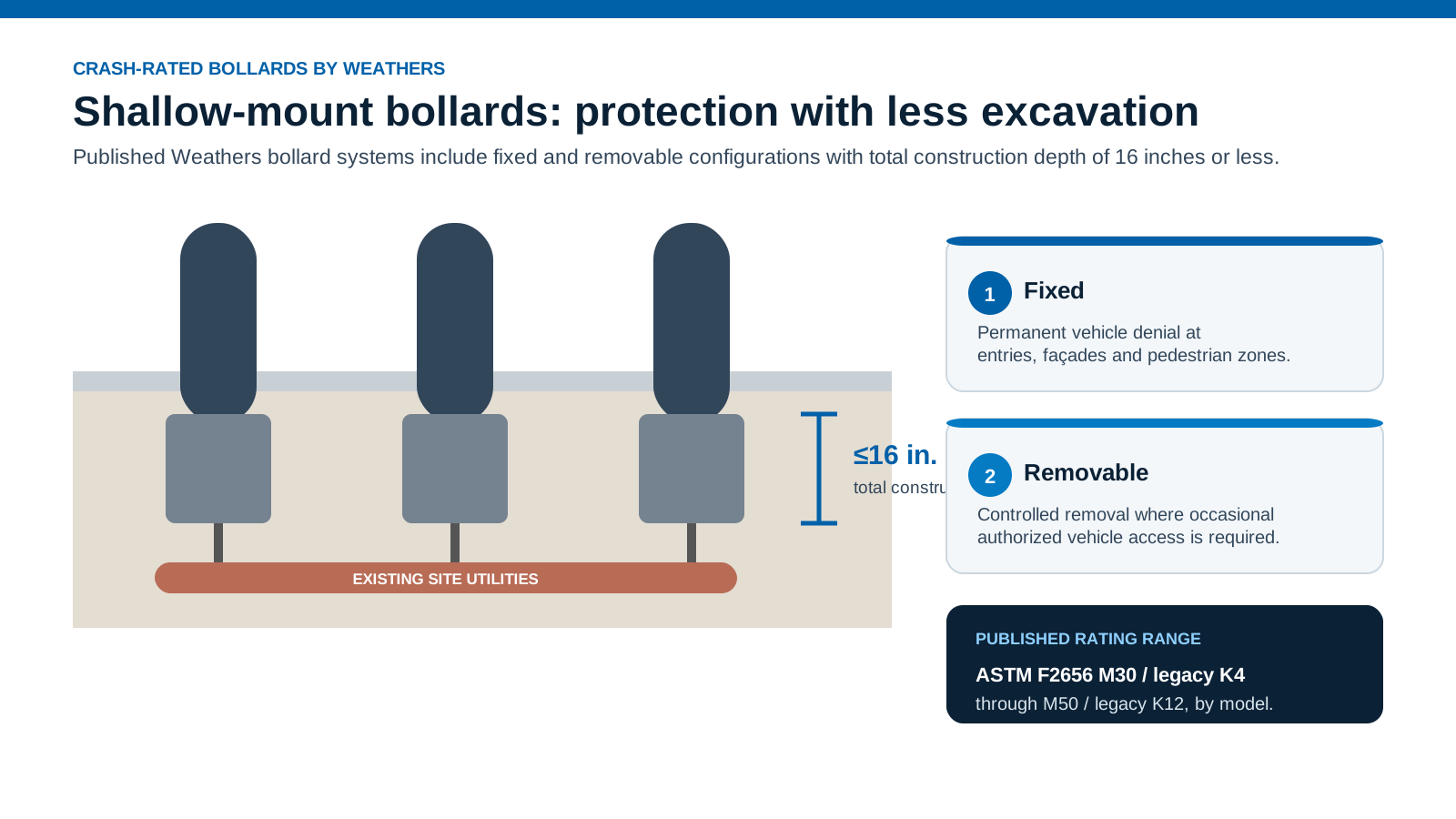
Shallow-mount construction
Published total construction depth of 16 inches or less. On a retrofit that is usually the difference between a straightforward install and a utility relocation.
Fixed or removable
Fixed bollards protect continuously. Removable systems hold the line and still permit authorized vehicle access when the operation requires it.
Grouped or individual
Installed as a continuous line or as discrete units protecting specific equipment, and adaptable to changing grade across a frontage.
Threat basis
Configurations are published from M30 through M50, plus U.S. Marshals Service standards. The threat basis is chosen from the site, not from the catalog.
Reading the standard
What a crash rating actually describes.
ASTM F2656 rates a barrier by the vehicle it stopped and how far that vehicle travelled past the line. Both halves matter, and the second one is the half most specifications forget.
| Designation | Test vehicle | Impact speed | Legacy DOS |
|---|---|---|---|
| M30 | 15,000 lb medium-duty truck | 30 mph | K4 |
| M40 | 15,000 lb medium-duty truck | 40 mph | K8 |
| M50 | 15,000 lb medium-duty truck | 50 mph | K12 |
Performance is configuration-specific. The tested basis for the exact quoted model is confirmed against current manufacturer documentation and issued with the submittal.
| Designation | Penetration | What it means on site |
|---|---|---|
| P1 | ≤ 3.3 ft | Suitable where people or the protected face are immediately behind the line |
| P2 | 3.31–23.0 ft | Requires standoff between the barrier and what it protects |
| P3 | 23.1–98.4 ft | Perimeter application with substantial standoff |
Designations above are the published definitions of the standard, not a claim about any specific product. Available configurations and the tests behind them are confirmed per project.
Where the line ends
A bollard stops a vehicle. It does not stop a round.
Crash-rated bollards are kinetic vehicle denial. They are not ballistic protection, and no crash test implies one.
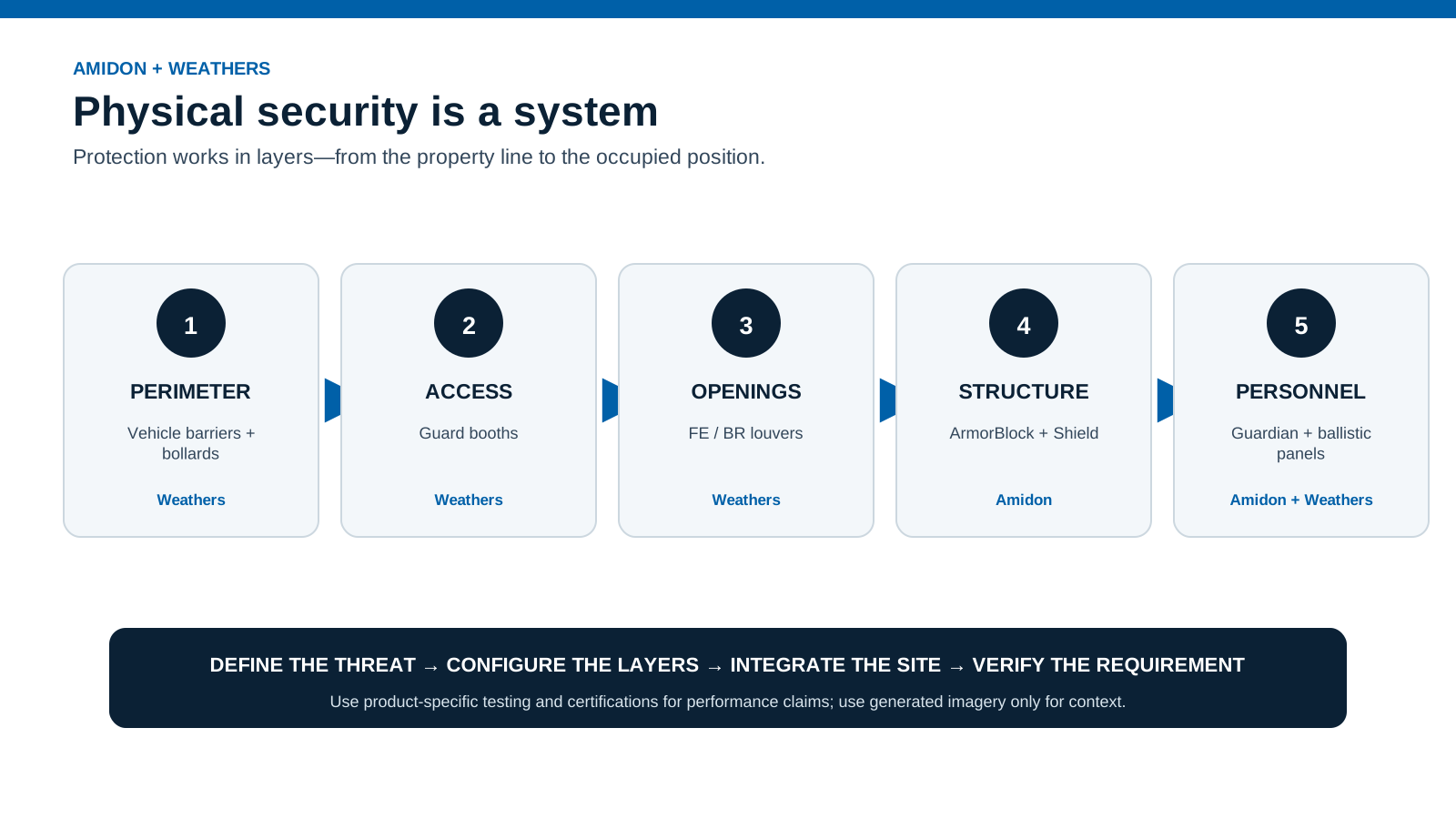
On most sites that matters, because the threat that arrives by vehicle and the threat that arrives on foot are the same afternoon. The bollard line is the outer layer. What it buys is standoff — and standoff is only worth something if the thing behind it is built to use it.
That is the part Amidon builds. ArmorBlock and Amidon Shield harden the structure the bollards are protecting, and we specify both halves against one threat basis rather than two.
From product to protected site
Four steps, in this order, every time.
- 1
Define
Threat basis, protected asset, approach speeds and geometry, site conditions, operating sequence, and the standard the specification has to satisfy.
- 2
Configure
Match the product configuration to the physical requirement — spacing, fixed versus removable, foundation depth against what is already in the ground.
- 3
Integrate
Coordinate with adjacent structures, utilities, access control, lighting, and the hardened envelope behind the line.
- 4
Field
Submittals, delivery, installation responsibilities, commissioning and close-out documentation confirmed before the system enters service.
Where it fits
Built for sites where a vehicle reaching the building is the event you are preventing.
- Building entrances and lobby frontages
- Government and diplomatic facilities
- Data centers and network facilities
- Pedestrian plazas and gathering areas
- Utility substations and energy assets
- Loading docks and service approaches
- Transformers and critical exterior equipment
- Secure campus streetscapes
Government & institutional procurement
Build a project configuration — not a shopping cart.
Public product literature is useful for screening a solution. It is not a submittal package, and it is not a basis for award.
Scoped before quotation
Threat basis, quantity, exact configuration, accessories, site requirements, delivery, installation responsibility and documentation — settled before a number is issued.
Documentation to the model
Current cut sheet and test report for the exact quoted configuration, not for the product family.
One responsible party
Amidon is the customer-facing path from requirement through fielding. You are not coordinating a manufacturer, an installer and a general contractor separately.
Specified with the envelope
The barrier line and the hardened structure behind it come from one threat basis and one drawing set.
Program questions
What to settle before ordering.
Why does shallow-mount matter on a retrofit?
A published total construction depth of 16 inches or less usually clears existing utilities. Deeper systems frequently do not, and the relocation cost can exceed the cost of the barrier. On an occupied site it can also be the difference between a weekend install and a month of closed frontage.
Are removable bollards tested to the same basis as fixed ones?
Both fixed and removable systems are published across multiple threat levels. The tested basis is specific to the model and its installation detail, so the exact removable configuration has to be confirmed for the project — a removable unit does not automatically share the basis of the fixed unit beside it.
How is bollard spacing selected?
From the threat vehicle, its approach geometry, pedestrian and accessibility requirements, the site layout, and the specific tested system. A generic spacing rule is a starting point for a sketch, not a basis for a specification.
Can bollards be combined with Amidon systems?
That is the normal case. Bollards form the outer vehicle-denial layer; ArmorBlock, Amidon Shield and the rest of the line protect the building or asset behind them. Specifying both against a single threat basis is the point of bringing them to one supplier.
Who manufactures these?
Amidon supplies and integrates crash-rated bollards built by a manufacturing partner in North Carolina. Your submittal package carries that manufacturer’s own test report for the exact configuration quoted, with the report number on it — which is a stronger document than a supplier’s restatement of someone else’s results. Manufacturer identity and current cut sheets are issued with the quotation.
Tell us what has to be protected — and what the site has to keep doing.
Give us the threat basis, the frontage, the operating requirement and the delivery location. We will come back with a configuration that meets the standard and fits what is already in the ground.
Discuss a bollard requirement