Briefing

Writing a Ballistic Wall Specification

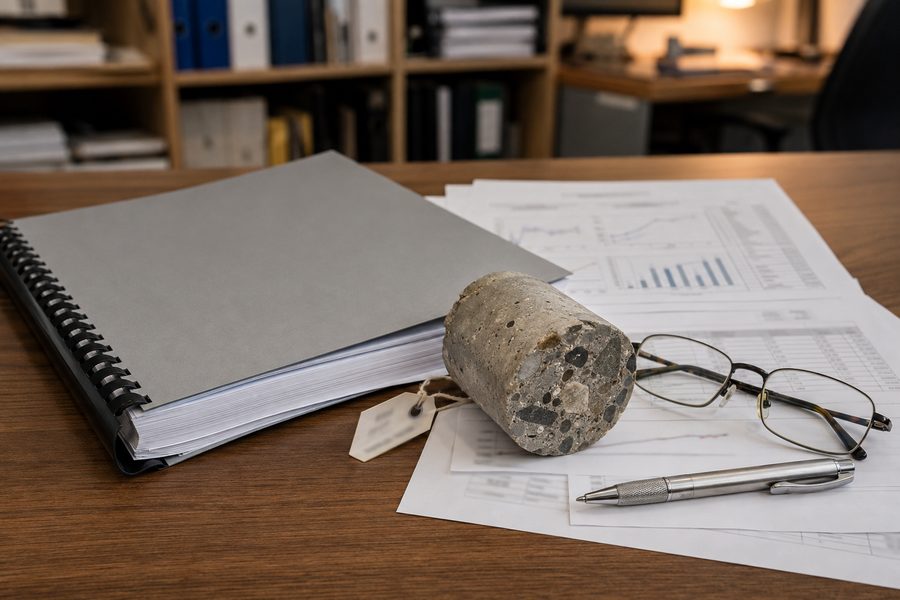
A submittal package of drawings, test documentation and concrete samples on a desk

A protective wall is not bought. It is specified, then built. Everything that decides whether it works — the threat it is meant to stop, the thickness that stops it, the door in the middle of it — is settled in a few paragraphs of a specification long before anyone orders material. When protection fails to show up on a finished project, the failure almost always traces back to those paragraphs, not to the product that was delivered against them.

This is a working note on what belongs in that section, written for the people who have to sign it: specifiers, structural and security engineers, contracting officers, program managers and facility owners. It contains no product recommendation. It is the checklist we use when we read someone else’s specification, and the gaps we find most often.

The unit of protection is the assembly, not the material

This is the single idea that, once internalised, fixes most of the rest. Ballistic performance does not belong to a material. It belongs to a complete, tested assembly: the material at a stated thickness, with stated reinforcement, stated fasteners, stated backing and stated joint treatment, struck by a stated round at a stated obliquity in a stated shot pattern.

Change any of those and you are outside the test. A panel that performed one way at four inches does not carry that result to three. A wall assembly result does not transfer to the same material in a different configuration, and it does not transfer to your building.

Specifications that name a product and a level, and stop there, have described a purchase rather than a protective system. What arrives on site will be the cheapest interpretation of that sentence, which is exactly what a competitive bid is designed to produce.

Standards are threat definitions, not a difficulty ladder

UL 752 defines bullet-resisting equipment by threat: the round, the number of shots and their spacing. NIJ-STD-0108.01 covers ballistic resistant protective materials. ASTM F2656 covers vehicle crash testing for perimeter barriers. ASTM E119 covers fire test response of building construction. On federal work, UFC 4-010-01 carries the minimum antiterrorism standards for buildings, and the Interagency Security Committee’s risk management process drives the facility security level that sits upstream of any of it.

Cite them. Cite the edition. What is worth being careful about is the difference between citing a standard and claiming status under one. A listing belongs to one manufacturer’s one tested assembly. It is not a property of a material sitting on a pallet, and it does not travel to a completed building. If a submittal says a product is “certified” or “rated” without naming the assembly, the laboratory and the date, the right response is to ask for those three things rather than to accept the adjective.

The same discipline applies in the other direction. A specification that asks for something no test protocol defines — “bulletproof,” a guaranteed outcome, a level range rather than a threat — creates a requirement nobody can demonstrate and a dispute nobody can win at close-out.

Twelve lines worth checking before the section goes out

None of these is exotic. Each one is something we have watched go missing on a real project, and each one costs more to add after award than before.

  • The threat, written as a threat. Round designation, number of shots, spacing, and whether blast, forced entry or vehicle impact is also in scope. A level number on its own is shorthand, and shorthand is what gets reinterpreted at bid.
  • The standard and its edition. Which protocol governs, and which version of it. “Per UL 752” without an edition is an invitation to argue later.
  • The assembly, described completely. Thickness, reinforcement, fill, facing, backing, fastener type and spacing, joint treatment. If the drawing shows it, say so; if it does not, say it here.
  • What a test report must contain. Laboratory, date, the configuration tested, the shot pattern, and the acceptance criteria used. A report predating the current formulation of a product describes a different product.
  • Every opening in the protected line. Doors, frames, hinges, closers, vision panels, transaction windows, pass-throughs. A protected wall with an unprotected door is a wall with a door in it.
  • The penetrations nobody draws. Conduit, outlet boxes, duct, sprinkler, data. These are field decisions unless the specification makes them design decisions.
  • Joints, seams and terminations. Wall-to-floor, wall-to-deck, wall-to-wall, and the top of the wall above the ceiling line. Field installations come apart at edges far more often than in the middle.
  • Who confirms the structure takes the load. Added mass on an existing floor or frame is an engineering question with a named responsible party. Name them in the section.
  • Code and life-safety interaction. Adding a protective layer to a fire-rated assembly can change the basis of that rating. Say who re-evaluates it and against what.
  • Installer qualification and inspection hold points. Who may install, what evidence of qualification, and what gets inspected and photographed before it is covered by finish. After drywall, nobody can verify anything.
  • Substitution language with actual criteria. “Or equal” is only meaningful if the section says equal in what respect, judged by whom, on what evidence. Equal on a data sheet is not equal on a tested assembly.
  • Close-out documentation. A record set showing what was actually installed and where. In ten years someone will renovate this building, and they need to know which walls are protective before they cut one.

Three phrases that cause trouble on bid day

“Bulletproof”
No protocol defines it, so no submittal can satisfy it. It sets an absolute standard in a document that will be read literally by a contracting officer and a lawyer. Write the threat instead.
“Rated to Level X”
Levels are threat definitions, not a rating ladder, and a listing attaches to one tested assembly rather than to a material. Ask for the assembly, the laboratory and the date.
“Ballistic panel” as a line item
Putting protection in a product line moves it out of the assembly. The openings, the joints and the penetrations then belong to nobody, which is how they end up unprotected.

Where the requirement lives on federal work

On a design-bid-build package the protective requirement usually belongs in the technical sections — Division 03 for cast-in-place concrete, Division 04 for masonry, Division 08 for openings — with the threat basis and the submittal requirements carried in the Division 01 general requirements so they apply across all three. On a design-build or a performance-based solicitation it belongs in the statement of work as a performance requirement with named evidence, because there is no technical section yet to put it in.

The failure mode is the same either way: the threat is stated in one place, the openings are procured in another, and no single party owns the continuity of the protected line. Somebody has to own it. If the acquisition strategy does not assign that ownership, the specification should.

How we read a specification

Amidon designs, supplies and installs protective construction, and a working day here frequently begins with someone’s draft section and a threat that has not been fully defined yet. Our first pass is the list above. The second pass is what the building actually is: existing construction, what stays occupied during the work, what is load-bearing, and where the protected line has to stop.

Only then does material selection come into it, and often the answer changes along the line — Amidon Shield cast in place where there is structure to take it, ArmorBlock where masonry crews and masonry methods are already on site, ballistic fiberglass where the protection has to disappear into an occupied interior. One protected line, changing material where the building changes, without changing who is responsible for it. Our design and engineering group does that work with the design team rather than after it.

We will also say when protection is not the right answer, or when the threat as written does not match the risk as described. That conversation is cheaper before the section is issued than after the bids come in.

Amidon is a Service-Disabled Veteran-Owned Small Business.

Send us the section you are working on

Tell us what you are protecting, from what, and what you have to build into. We will come back with the questions that have to be answered before the section can be written, an outline of which specification sections are involved, and where we think the protected line has a gap. No obligation attached, and nothing you send is shared outside Amidon.

Who you are

We reply within one business day. Or call (866) 426-4366.

Rather talk it through first?

Tell us what you are protecting and from what, and we will tell you which material fits and how it installs.

Talk to Amidon