
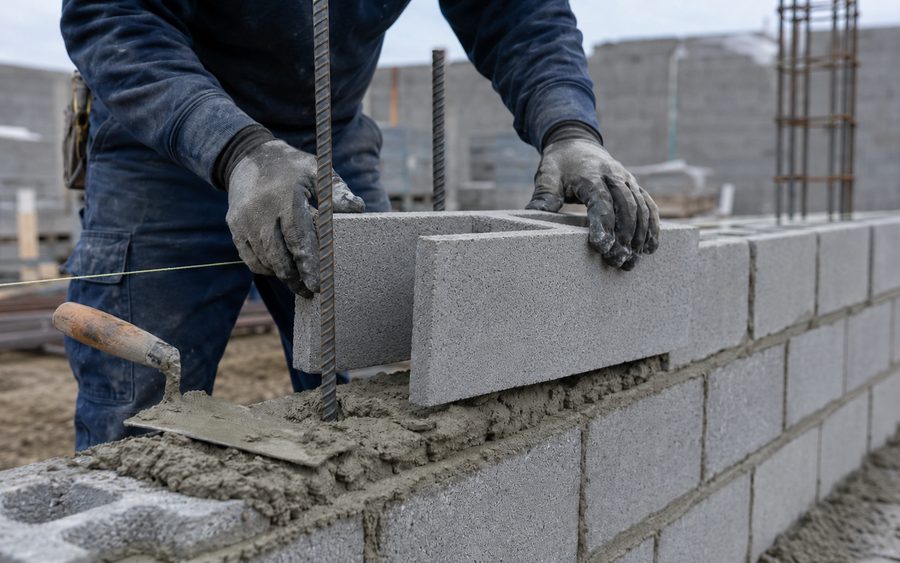
ArmorBlock® is a fillable concrete masonry unit (CMU) designed to create reinforced protective wall assemblies using familiar masonry construction methods. The blocks are laid much like conventional CMU, then reinforced and filled with Amidon Shield® protective concrete to create a hardened wall system. The concept is intentionally straightforward: build it like a masonry wall, but engineer the completed assembly for protection.
More Than a Concrete Block
A conventional CMU wall is primarily designed to satisfy structural and architectural requirements — and it does that job well. ArmorBlock adds another objective: protecting the people, equipment, and infrastructure behind the wall. It uses specially configured masonry units that, once reinforced and filled with Amidon Shield, become part of a hardened protective assembly. This lets architects, engineers, contractors, and facility owners build protection directly into the wall rather than adding a separate protective layer afterward.
ArmorBlock walls can be considered for government and military facilities, police and public-safety buildings, critical infrastructure, utility and energy facilities, data and communications facilities, security walls and protected areas, safe rooms and hardened enclosures, and live-fire training facilities.
How ArmorBlock Works
ArmorBlock is installed using conventional masonry techniques. The wall is laid, reinforced as required by the engineered design, and the block cavities are filled with Amidon Shield protective concrete — a proprietary cementitious admixture used to create high-performance, shock-absorbing concrete. The resulting wall combines the familiar construction characteristics of CMU with the energy-absorbing characteristics of Shield.
Rather than relying on hardness alone to resist an impact, the Shield material is designed to absorb and dissipate energy while limiting cracking, fragmentation, and spalling. The objective is not simply to stop a projectile, but to preserve the integrity of the protective wall surrounding the impact area.
Familiar Construction, Different Performance
One of ArmorBlock’s primary advantages is constructability. Protective construction can otherwise require specialized panels, steel systems, complex connections, or components manufactured remotely and transported to the project. ArmorBlock instead allows the protective wall to be built using familiar masonry practices.
A typical ArmorBlock is nominally 8 inches high × 8 inches deep × 16 inches wide. Once the wall is assembled, reinforced, and filled with Amidon Shield, the individual units become part of a continuous protective wall assembly — simplifying coordination with conventional construction while making the protective system part of the building itself.
ArmorBlock and Amidon Shield Are Different Products
It is important to distinguish the two. Amidon Shield® is the cementitious admixture technology; it can be used independently in cast-in-place, precast, and other reinforced concrete applications. ArmorBlock® is the fillable CMU system designed to use Shield to create reinforced protective masonry walls. A project does not have to use ArmorBlock to use Shield — the appropriate method depends on the structure, threat requirements, engineering design, and construction approach.
Ballistic Protection Is an Assembly
ArmorBlock should not be thought of as an individual “bulletproof block.” Ballistic performance belongs to the completed, tested wall assembly — including the ArmorBlock units, Shield fill, reinforcement, wall thickness, construction details, and other elements of the tested configuration.
ArmorBlock reinforced wall assemblies have undergone independent ballistic testing in accordance with UL 752 protocols, with video and photographic records of testing, including testing conducted at National Technical Systems’ Chesapeake facility. This distinction matters for architects and engineers: project-specific protection should be based on the appropriate tested and engineered configuration, rather than assuming an individual material automatically provides a particular level of protection.
Why Use ArmorBlock Instead of Conventional CMU?
The simplest answer is that the two products serve different purposes. Conventional CMU is an excellent, widely understood construction material — but ordinary concrete masonry is not inherently engineered as a high-threat protective system. ArmorBlock lets the contractor retain the advantages of masonry construction while creating a wall specifically intended for protective applications.
That brings several practical advantages: familiar installation (qualified masonry contractors use established practices rather than learning a new system); integrated protection (the protective material becomes part of the wall, not a secondary layer); local construction (Amidon Shield can be incorporated into locally supplied concrete, reducing dependence on transporting large finished components); design flexibility across new construction, interior protective walls, hardened corridors, secure enclosures, and training facilities; and repairability, since masonry provides a familiar framework for detailing openings, penetrations, intersections, and future modifications.
Where Does ArmorBlock Fit?
ArmorBlock is particularly useful when a project needs the practicality of masonry construction but conventional CMU does not provide the required protective performance. A facility may need only selected walls hardened; ArmorBlock lets those walls be incorporated into the architectural design without requiring the entire building to use a specialized construction system. For more demanding applications, it can become one component of a larger protective envelope incorporating hardened doors, ballistic glazing, protected penetrations, and structural reinforcement.
Built on Proven Amidon Technology
ArmorBlock is part of a broader family of protective concrete technologies developed by Amidon. The earlier Amidon Ballistic Concrete technology has a long history in U.S. military live-fire training facilities, while Shield and ArmorBlock extend the underlying protective-material approach into conventional building and infrastructure applications.
The result is a relatively simple idea: take a construction method contractors already understand, and engineer the completed wall to do something conventional masonry was never intended to do. That is ArmorBlock.