
Turning advanced research into deployable technology is a different job than doing the research in the first place — and that difference is why national laboratories partner with private industry.
National laboratories possess extraordinary scientific, engineering, testing, and computational capabilities — extensive laboratories, specialized personnel, sophisticated modeling resources, and federal funding. It may seem surprising that organizations of that scale would seek partnerships with comparatively small private companies. The reason is straightforward: the government does not partner with industry because it lacks technical capability. It partners with industry because government laboratories and commercial organizations are designed to solve different parts of the problem. For emerging technologies such as Small Modular Reactors (SMRs) and microreactors, those differences can make collaboration particularly valuable.
National Laboratories Have a Different Mission
National laboratories are designed to address some of the nation’s most difficult scientific and national-security problems. Their capabilities include advanced modeling, materials science, nuclear engineering, threat analysis, testing, validation, and systems engineering. They can determine extraordinarily complex things: what happens to a structure during a blast event, how radiation propagates through different materials, how a system behaves under extreme thermal conditions, how critical infrastructure should respond to defined threats, and what level of protection a particular mission requires.
But determining what must happen and developing a practical way of building it repeatedly in the field are different challenges. That distinction creates an important role for industry.
The SMR Envelope Is a Systems Problem
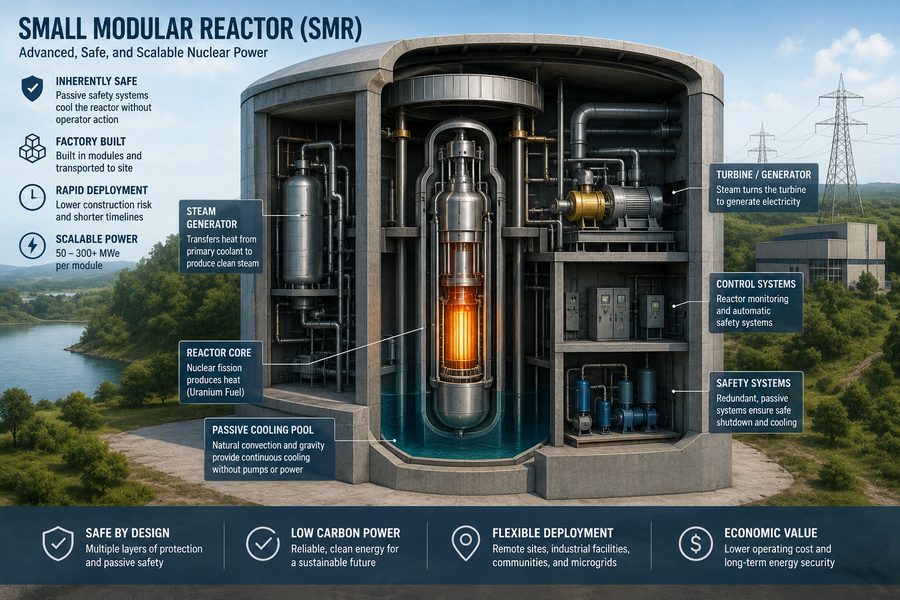
The reactor itself represents only part of an SMR deployment. The surrounding infrastructure may need to address many requirements simultaneously — radiation attenuation, physical security, blast resistance, ballistic protection, fire and thermal exposure, electromagnetic effects, structural requirements, transportation, installation, maintenance, and eventual replacement or reconfiguration.
These requirements interact. Increasing the thickness of a protective wall may improve one characteristic while increasing weight and transportation demands. Adding shielding may interfere with heat rejection. A highly permanent structure may provide excellent protection but undermine the mobility that made a microreactor attractive in the first place. The challenge becomes: how do you create a protective envelope that satisfies the required threats while remaining practical to manufacture, transport, install, operate, repair, and modify? That is where collaboration between government researchers and specialized industry partners becomes valuable.
Government Defines the Problem. Industry Helps Make It Practical.
A national laboratory may possess world-class capabilities for determining loads, threats, radiation environments, material behavior, and system requirements. An industry partner contributes a different set of capabilities: materials development (formulations produced, modified, manufactured, and tested against specific requirements); manufacturing knowledge (a theoretically successful material still needs to be mixed, cast, cured, transported, installed, inspected, and reproduced consistently); construction experience (laboratory performance must translate into something contractors can actually build); rapid iteration; and supply-chain knowledge. The two organizations do not duplicate one another — they complement one another.
Why Specialized Companies Can Be Valuable
A government organization investigating an emerging problem does not necessarily need another large defense contractor. Sometimes it needs a company with experience in a very specific technical intersection. For Amidon Labs, that intersection is advanced cementitious materials and protective construction systems — materials and systems intended for ballistic protection, blast resistance, extreme thermal exposure, structural protection, and modular construction.
That raises an interesting question for an SMR security program: could materials originally developed for extreme physical protection be adapted into a multi-threat protective envelope for an SMR or microreactor? The answer should not be assumed. It should be engineered, modeled, tested, and validated — precisely the kind of question where government-industry collaboration is productive.
Existing Technology Becomes the Starting Point
A partnership does not require claiming that an existing commercial product already solves every SMR requirement. The more credible approach is the opposite: existing Amidon technologies can provide starting points from which specialized government configurations could be developed.
Amidon Shield® provides an engineered cementitious platform that can be evaluated and potentially modified for structural, shielding, thermal, and protective-envelope requirements. ArmorBlock® provides a modular construction method for replaceable, rapidly constructed, or reconfigurable protective barriers. Amidon Ballistic Concrete systems provide experience with substantial hardened structures designed to absorb repeated ballistic energy while maintaining protective integrity. CarbonCrete™, currently under development, introduces carbon into the cementitious matrix and presents additional research opportunities involving thermal behavior, radiation interaction, durability, and structural performance.
Importantly, none of these capabilities should be represented as nuclear-qualified without the necessary testing and validation. Their value is that they provide mature or developing technology platforms from which purpose-built solutions can be created.
Why GOTS Can Make the Partnership More Attractive
For certain national-security applications, the desired result may be a Government-Off-The-Shelf (GOTS) technology. That changes the relationship. The objective is no longer simply “government buys a product.” Instead, government and industry develop a solution based on applicable technologies, testing, and engineering, with the resulting capability structured for government ownership and sustainment. This gives the government greater control over future production, sourcing, modification, deployment, and configuration — and lets the technology evolve independently of a single commercial product. For a long-lived national-security program, that independence can be extremely important.
A Branchable Technology Architecture
SMR and microreactor requirements will continue to evolve, and different deployments may require very different levels of protection. A reactor at a permanent installation has different requirements than one at a remote military site; an Arctic deployment differs from a desert one; a buried installation differs from a transportable surface system. Instead of attempting one universal enclosure, a collaborative program could establish a common protective architecture with multiple branches — a base structural envelope extended into ballistic, blast, radiation-shielding, thermal, electromagnetic, buried-installation, and transportable configurations. The government retains the core architecture while individual configurations evolve as missions and threats change.
The Real Value of the Partnership
The fundamental question is not whether a national laboratory could develop advanced protective materials without Amidon — given sufficient resources and time, it almost certainly could. The better question is whether Amidon provides existing technology, specialized experience, manufacturing knowledge, intellectual property, and development momentum that could let the government reach a deployable solution faster and with less technical risk. If the answer is yes, collaboration makes sense.
Government laboratories bring extraordinary scientific, analytical, testing, and national-security expertise. Industry brings specialized technologies, manufacturing experience, rapid iteration, supply-chain knowledge, and field implementation. Together, those capabilities can move an idea through the difficult transition from requirement to science to material to system to testing to manufacturing to deployment.
Where Amidon Labs Fits
Amidon Labs should not approach an SMR security program claiming to have already solved the nuclear industry’s protective-envelope problem. A stronger position is this: we have developed unusual materials and construction technologies for demanding protective environments; you understand the SMR mission, threats, nuclear requirements, and validation environment far better than we do; we understand our materials, protective construction, manufacturing, and field deployment. There may be an opportunity to combine those capabilities and develop something neither organization would build as efficiently on its own.
And if the ultimate requirement is a government-owned technology, Amidon can help create the capability, validate it, transition it, and let the resulting system become part of the government’s technology portfolio. The objective is not to sell the government a wall. The objective is to help the government develop a better protective envelope.