
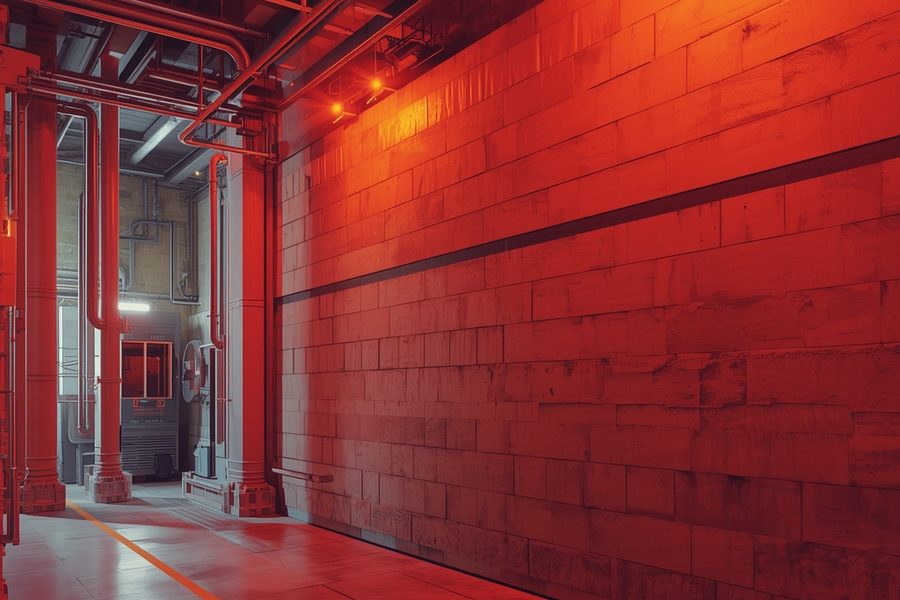
Not every threat comes from a hostile actor. In data centers, manufacturing plants, and utility facilities, one of the most persistent problems is something quieter and constant: vibration and low-frequency noise from heavy mechanical equipment. Chillers, compressors, generators, and turbines transmit energy through the structure of a building — not just through the air — and lightweight partitions simply lack the mass to stop it.
That energy shows up as cracked drywall, loosened fasteners, equipment fatigue, and noise that carries into occupied spaces. Conventional fixes — framed assemblies, resilient channels, active isolation — can help, but they add complexity, need tuning, and degrade over time in harsh industrial conditions.
Amidon ArmorBlock takes a different approach: mass. As a high-density, fillable concrete masonry unit, ArmorBlock attenuates structure-borne vibration and low-frequency noise through three physical mechanisms — mass loading, structural stiffness, and continuity. There is nothing to calibrate and nothing to wear out. The wall works because of what it is, not because of a mechanism that can fail.
Because ArmorBlock is modular, it can be deployed, reconfigured, or expanded without demolition. A mechanical yard can be enclosed, a generator separated from an occupied area, or a compressor bay isolated — using conventional material-handling equipment and standard installation techniques. It suits both new construction and retrofit, where minimizing downtime matters.
ArmorBlock is built for the environment it lives in: continuous vibration, heavy equipment traffic, temperature swings, and moisture. It is designed for industrial conditions, not office interiors — and it holds up.
ArmorBlock does not replace engineering analysis. It simplifies it. By using concrete where concrete works best, it gives facility teams a durable, predictable, high-mass solution for a job that calls for exactly that.