
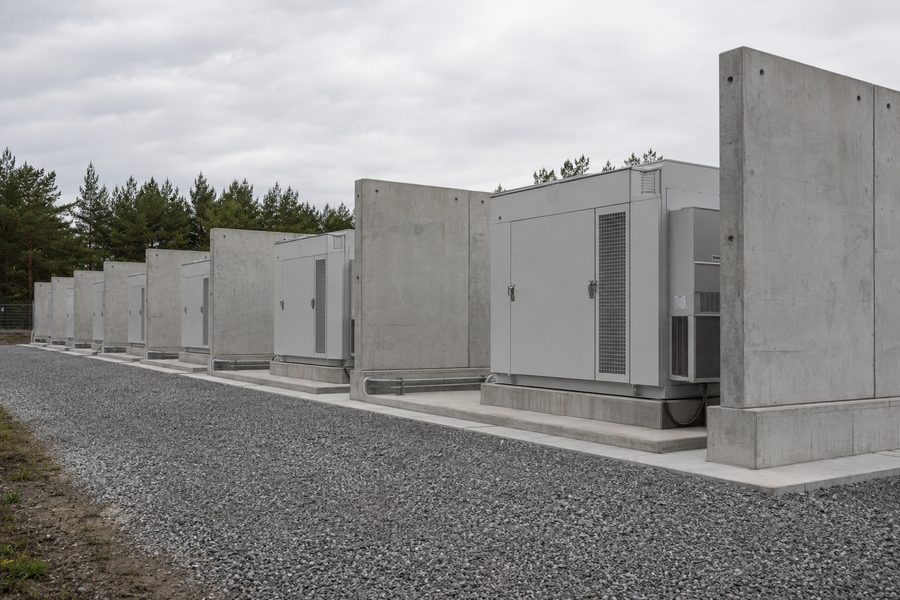
A battery energy storage site is easy to underestimate as a security problem. It is usually unstaffed, often remote, and looks like rows of identical cabinets behind a fence. Behind that appearance sits a facility with a grid interconnection, high-value equipment and long lead times for replacement parts, and a revenue model that depends on being available the moment it is dispatched.
This note covers physical security for those sites: the ballistic, forced-entry and vehicle threats an owner should evaluate, and how each one is addressed in the design. It is written for owners, developers, EPC teams and the engineers who specify the site.
A separate question: fire and separation
One boundary first, because it is often blurred. Fire protection and separation at a storage site are governed by their own framework. NFPA 855 sets requirements for the installation of stationary energy storage systems, and UL 9540A is the test method used to evaluate fire propagation in battery systems. Those questions are answered by the storage supplier’s test data, the project’s fire protection engineer and the authority having jurisdiction.
Physical security is a different question. A wall, barrier or bollard line placed for security does not answer any part of the fire and separation analysis, and it should never be assumed to. What the security design must do is respect that analysis: it must not block required separation, ventilation, explosion relief paths or responder access. The rest of this note is about physical security only.
Ballistic threats
Rifle fire from outside the fence is the threat that a fence does nothing about. On a storage site, the battery enclosures themselves are numerous and individually replaceable. The assets with the largest consequence are usually elsewhere: the power conversion systems, the main step-up transformer, the medium-voltage switchgear and the control and communications equipment that ties the site to the grid operator. Losing one of those can take the whole site offline, and some of them have replacement times measured in many months.
Ballistic protection is therefore targeted. The evaluation identifies likely firing positions and sightlines, and protective walls or screens are placed between them and the high-consequence equipment. The threat should be written as a threat, with the round, the number of shots and the spacing, and the standard that defines it, usually UL 752. The test evidence should match the assembly being built.
Forced-entry threats
Forced entry is the more frequent problem at most sites. Copper and equipment theft, vandalism and tampering with control cabinets all start with someone getting through a fence and then through a door, a panel or a cabinet. The items to specify are the control building or control enclosure, its doors, frames and hardware, communication cabinets, and any opening that leads to equipment an intruder could disable.
Forced-entry resistance is time. The question is how long a given opening holds against hand and power tools, and whether that time is longer than the time it takes detection and response to reach the site. An enclosure that holds for the response interval is protecting the asset. One that does not is only recording the event.
Vehicle threats
Vehicle threats on a storage site come in two forms. The deliberate one is a vehicle driven at equipment or through the perimeter, addressed with barriers and bollards specified against a defined vehicle and approach speed under ASTM F2656. The accidental one is a maintenance truck, crane or delivery vehicle striking an enclosure inside the site, addressed with protective curbs, guard posts and layout. Both belong in the plan, and both depend on the approach geometry: the speed a vehicle can actually reach is set by the road layout and the gate position, and it determines everything downstream.