Briefing

Physical Protection for Data Center Campuses

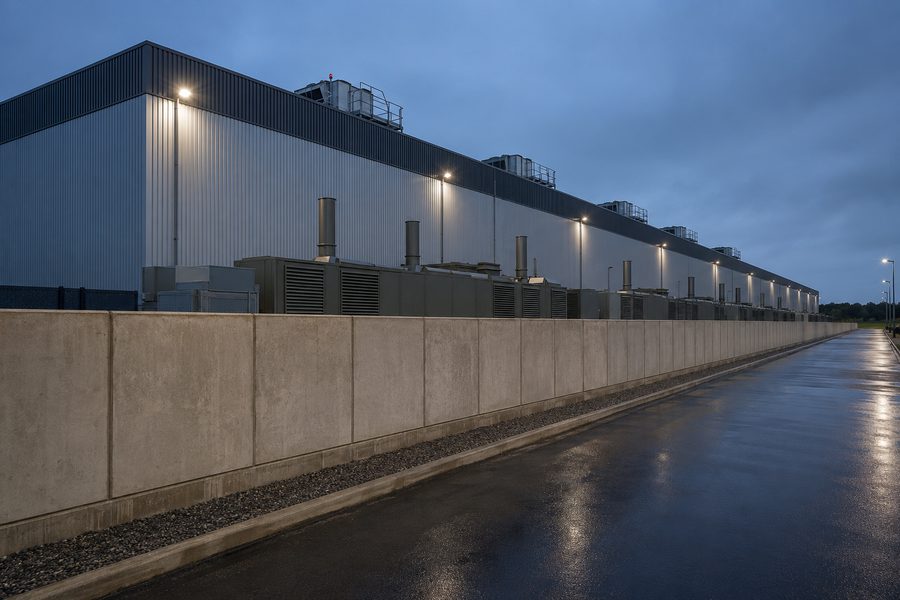
Precast concrete perimeter wall along a data center at dusk, with generator and switchgear enclosures behind it

Most data center security programs are built around the server hall. Badges, mantraps, cameras, cages and visitor logs all concentrate on the room where the computing equipment sits. The equipment that keeps that room running usually sits somewhere else: in a utility yard, a generator yard, a fuel area, a cooling plant and a set of fiber vaults, often behind nothing more than a fence. If any one of them is lost, the hall goes down with it, however well its doors are controlled.

This note is written for owners, developers, engineers, specifiers and contracting officers planning a data center campus or an expansion of one. It sets out where physical exposure tends to sit outside the building, how to describe the threat for each part of the campus, and what to write into the specification so that protection is designed rather than improvised after the yards are built.

Map the dependency chain before drawing the perimeter

The first step is a list, not a product. Every element whose loss would stop the server hall belongs on it, along with where that element physically sits. On a typical campus the list includes the utility service entrance and its transformers, the switchgear, the standby generators and their radiators, the bulk fuel storage and day tanks, the chillers, cooling towers or dry coolers, the water supply, and the points where fiber enters the property and the building.

For each item, the useful questions are simple. Is it inside or outside the secure perimeter? Can it be seen from a public road or a neighboring parcel? Can a vehicle reach it? Is there a single point where damage would take out more than one of its redundant paths at once? Redundancy on a one-line diagram does not help if both feeds, both fuel lines or both fiber routes pass through the same yard, the same duct bank or the same wall.

Write the threat for each part of the campus

Different parts of a campus face different threats, and each one should be written as a threat rather than as an adjective. A generator yard next to a public road may need to be evaluated against a rifle fired from outside the fence. A gate on a long straight approach may need to be evaluated against a vehicle. A fiber vault or fuel fill point may need to be evaluated against forced entry with hand and power tools. Tampering and sabotage by someone with legitimate access belong on the list as well.

Each threat has its own reference. ASTM F2656 is the usual test standard for vehicle barriers, and it defines the test vehicle, the impact speed and the penetration measured. UL 752 and NIJ-STD-0108.01 are the usual references for ballistic threat definitions, which state the test round and the conditions under which it is fired. The specification should cite the standard and its edition for each threat, and say which part of the campus each one applies to.

Five places protection is often missing

These are the areas where campus protection most often stops short. Each one is easy to address in design and difficult to add once the yard is built and energized.

  • Generator yards. Radiators, fuel lines and control cabinets are exposed on most generator enclosures. A screen wall that hides them from the road does not stop a round unless the wall is a tested ballistic assembly for the threat named.
  • Transformers and switchgear. Utility and site transformers are large, slow to replace and often placed at the property edge for the utility’s convenience. Their location should be a security decision as well as an electrical one.
  • Fuel storage and fill points. Bulk tanks and the connections where delivery trucks fill them need forced-entry and vehicle protection, and the delivery route has to stay open for the trucks that refuel the site during an outage.
  • Fiber entry and vaults. Diverse fiber routes lose their value where they converge. Vault lids, handholes and building entry points deserve the same attention as the doors of the hall.
  • Cooling plant. Chillers, towers and dry coolers need large openings for airflow. Every louver or grille in a protective wall is a gap in the assembly unless the opening itself is protected to the same threat.

Openings, airflow and access decide the result

Equipment yards are hard to protect because the equipment has to breathe and be serviced. Generators and cooling plant need air in volume, and maintenance crews need to bring in cranes, replacement units and fuel trucks. A yard enclosure is only as good as its gates, louvers and service openings. Those openings should be drawn, sized for airflow and access, and specified as protective assemblies tested to the same threat basis as the walls around them.

Joints and terminations deserve the same care. A protective wall that ends short of grade, stops at a gap left for a duct bank, or meets a gate with a wide clearance has a path through it. The specification should describe how the wall meets the ground, the gate, the next panel and every penetration.

Lay out the final campus, not only phase one

Campuses are usually built in phases, with new halls, generator yards and substations added as capacity grows. Perimeter and yard protection laid out only for the first phase tends to be cut open later to make room for the second. The site plan should show the protected line for the full build-out, with the points where it will be extended, so that each phase adds to the line instead of breaking it. Construction is also a period of exposure in its own right: temporary fencing, open trenches and contractors moving through an energized site should be covered in the phasing plan.

Leave a record that survives the project

Close-out documents should show which walls, gates and enclosures are protective, the threat each was designed for, and where the openings and penetration treatments are. Data center equipment is replaced on a much shorter cycle than the building around it. Without that record, a future generator swap or cooling upgrade can remove part of a protective enclosure without anyone knowing it was there.

Where Amidon fits

Amidon designs, supplies and installs protective construction for the yards and buildings that keep a data center running. Amidon Shield is used in cast-in-place and precast protective walls and enclosures. ArmorBlock brings the same material into masonry construction where a wall can be built with masonry crews and methods. Amidon also supplies vehicle barriers, forced-entry and ballistic louvers for openings that have to move air, and perimeter and access security products. Amidon’s design and engineering group works with the owner’s team on the dependency map, the threat for each part of the campus and the protected line before material is selected.

Amidon is a Service-Disabled Veteran-Owned Small Business.

Critical infrastructure applications

Planning a data center campus or expansion?

Send the site plan, the equipment yards and vaults that need protection, the threat your assessment identified and the phasing you expect. Amidon will respond with a material and assembly approach for engineering review.

Talk to Amidon