
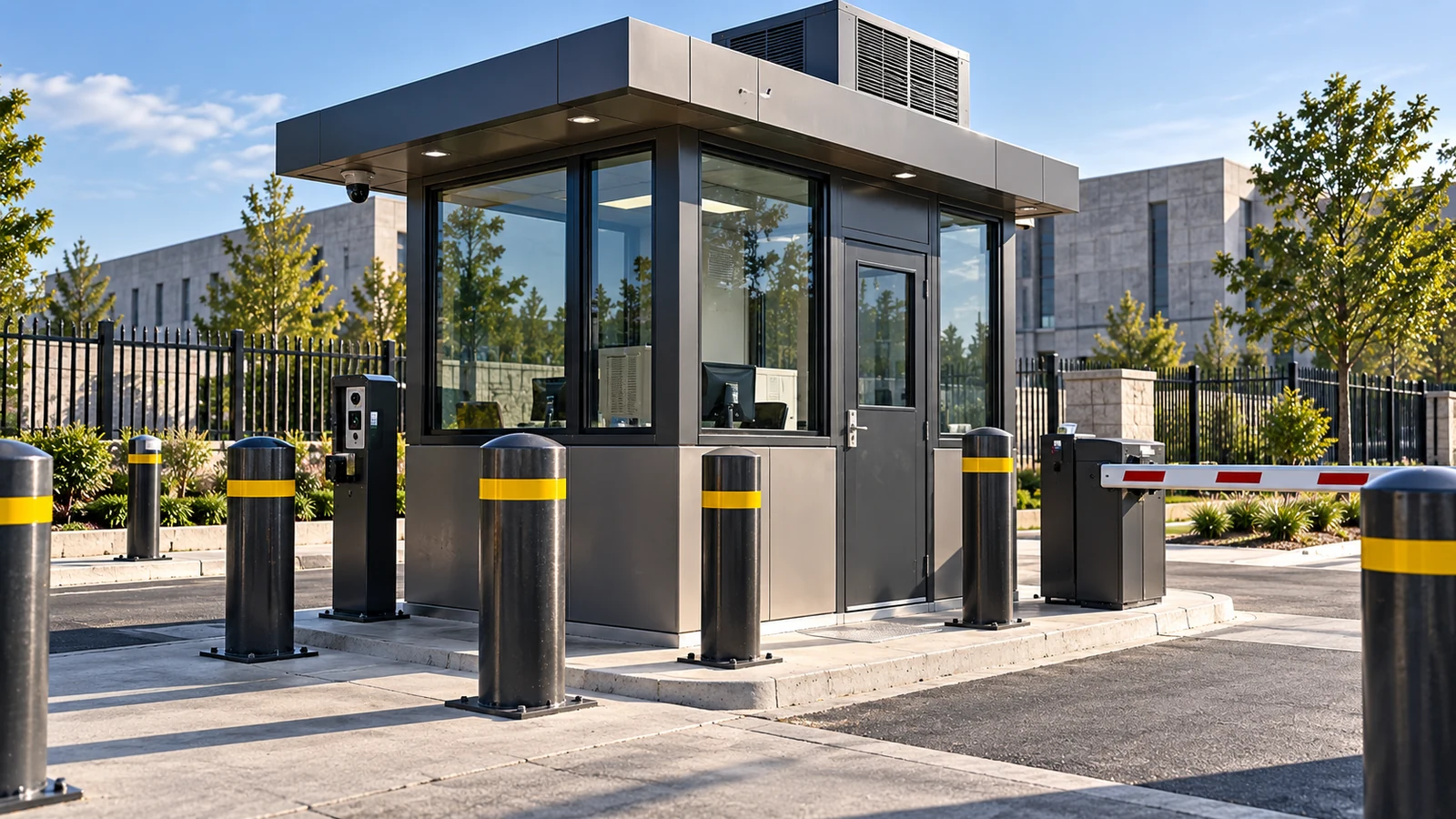
A guard booth is a small building with a large job. It has to protect a person who must see out in every direction, speak to drivers, take and return documents, and stay comfortable through a full shift. Each of those duties puts an opening in the protective envelope. A requirement that reads only “bullet-resistant guard booth” with a standard and a level attached leaves most of those openings unspecified.
This note is written for specifiers, engineers, facility owners and contracting officers who write or review requirements for staffed gates and checkpoints. It sets out what a booth requirement should cover and what evidence to ask for.
Start with the post, not the catalog
The booth exists to support a set of duties. Before a ballistic level is chosen, the requirement should record what the officer does at the post: which lanes are watched, whether credentials are checked through a window or at a pass-through, whether the officer leaves the booth to inspect vehicles, and what equipment runs inside. Those duties decide how much glazing the booth needs, where the door goes, whether a transaction drawer or speak-through is required, and what power, data and climate loads it carries.
The threat basis comes from the facility’s risk assessment. It should name the weapons and ammunition the booth must resist, and the directions an attack can come from. A requirement that protects only the face toward the road may leave the officer exposed from the side or rear.
Name the standard, the edition and the level
UL 752, the Standard for Bullet-Resisting Equipment, is a common reference for booth walls, doors and glazing. It covers the performance of materials, devices, assemblies and fixtures used to create bullet-resisting barriers. Under it, a sample passes when no projectile penetrates it, when no fragments of the projectile or spall from the protected side embed into or damage the cardboard indicators placed behind it, and when no opening forms large enough to insert the muzzle of a weapon designed for that ammunition. NIJ Standard-0108.01, Ballistic Resistant Protective Materials, published in September 1985, is another reference that appears in specifications for protective materials.
The two standards define their levels differently, and a level under one is not a level under the other. A requirement should name the standard, the edition or year, and the level, and should state that the level applies to every element that forms the protective line. A level describes the weapon and ammunition the sample was tested against.
Every face of the booth is part of the envelope
A booth is protected on all sides only if every element on all sides is protected to the same threat. That includes the walls, the door and its frame, the glazing and its frames and stops, the joints where glazing meets wall, and the lower wall below the windows where an officer may be seated. Where the threat analysis shows that rounds can arrive from above, from elevated ground, a nearby structure or a steep approach, the roof needs its own requirement. Where the booth sits on a raised pad or over a crawl space, the floor may need one as well.