Briefing

How to Write a Ballistic Requirement for a Guard Booth

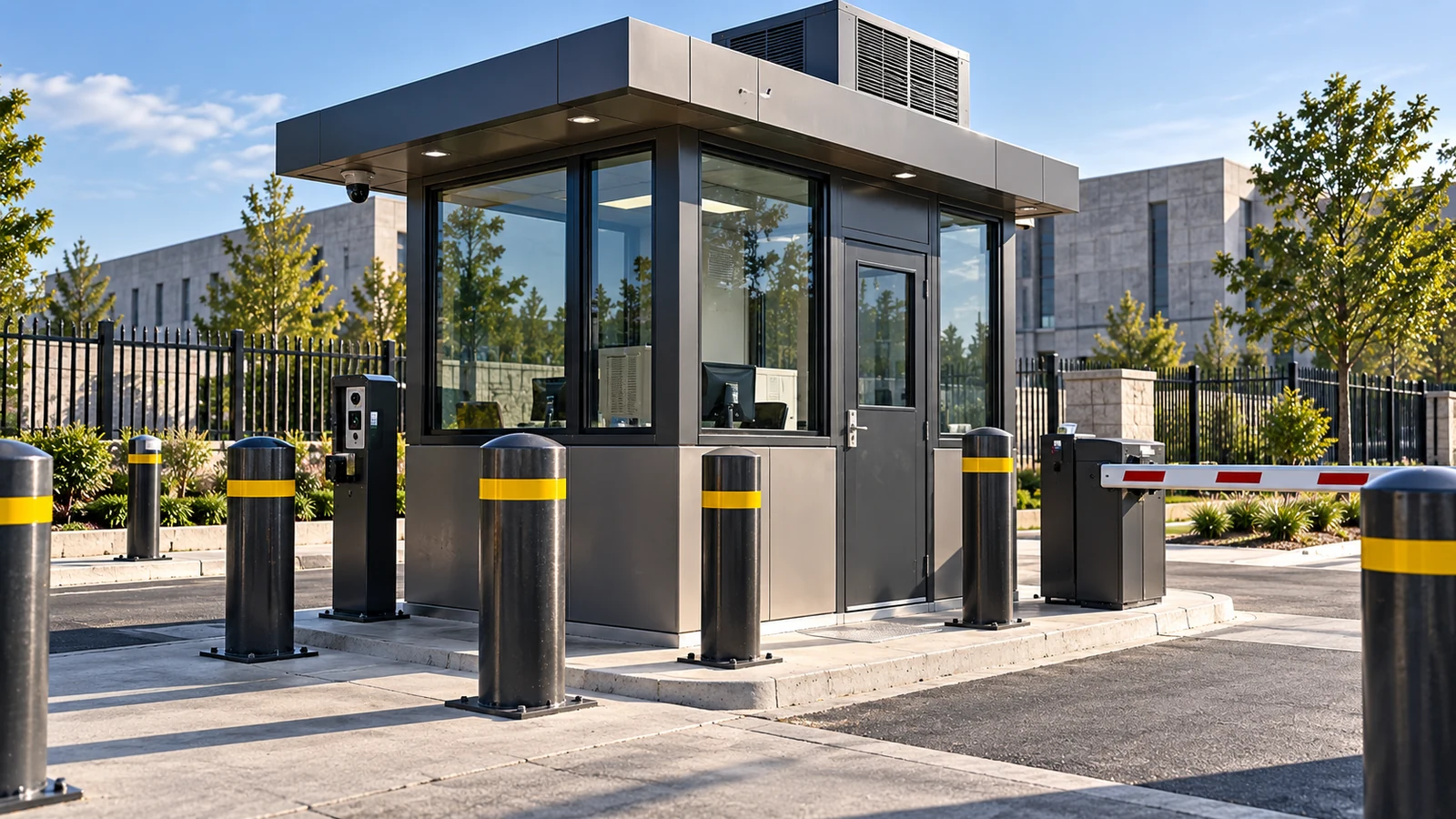
A guard booth with large glazed windows and a roof-mounted climate unit at a vehicle gate, with bollards and a lift-arm barrier in front

A guard booth is a small building with a large job. It has to protect a person who must see out in every direction, speak to drivers, take and return documents, and stay comfortable through a full shift. Each of those duties puts an opening in the protective envelope. A requirement that reads only “bullet-resistant guard booth” with a standard and a level attached leaves most of those openings unspecified.

This note is written for specifiers, engineers, facility owners and contracting officers who write or review requirements for staffed gates and checkpoints. It sets out what a booth requirement should cover and what evidence to ask for.

Start with the post, not the catalog

The booth exists to support a set of duties. Before a ballistic level is chosen, the requirement should record what the officer does at the post: which lanes are watched, whether credentials are checked through a window or at a pass-through, whether the officer leaves the booth to inspect vehicles, and what equipment runs inside. Those duties decide how much glazing the booth needs, where the door goes, whether a transaction drawer or speak-through is required, and what power, data and climate loads it carries.

The threat basis comes from the facility’s risk assessment. It should name the weapons and ammunition the booth must resist, and the directions an attack can come from. A requirement that protects only the face toward the road may leave the officer exposed from the side or rear.

Name the standard, the edition and the level

UL 752, the Standard for Bullet-Resisting Equipment, is a common reference for booth walls, doors and glazing. It covers the performance of materials, devices, assemblies and fixtures used to create bullet-resisting barriers. Under it, a sample passes when no projectile penetrates it, when no fragments of the projectile or spall from the protected side embed into or damage the cardboard indicators placed behind it, and when no opening forms large enough to insert the muzzle of a weapon designed for that ammunition. NIJ Standard-0108.01, Ballistic Resistant Protective Materials, published in September 1985, is another reference that appears in specifications for protective materials.

The two standards define their levels differently, and a level under one is not a level under the other. A requirement should name the standard, the edition or year, and the level, and should state that the level applies to every element that forms the protective line. A level describes the weapon and ammunition the sample was tested against.

Every face of the booth is part of the envelope

A booth is protected on all sides only if every element on all sides is protected to the same threat. That includes the walls, the door and its frame, the glazing and its frames and stops, the joints where glazing meets wall, and the lower wall below the windows where an officer may be seated. Where the threat analysis shows that rounds can arrive from above, from elevated ground, a nearby structure or a steep approach, the roof needs its own requirement. Where the booth sits on a raised pad or over a crawl space, the floor may need one as well.

Seven things a guard booth requirement should state

Each of these should be written down, so that the submitter has something to test against and the owner has something to accept against.

  • The duties of the post. What the officer does, which lanes are served, and what equipment runs inside the booth.
  • The threat. The weapons, ammunition and directions of attack, drawn from the facility’s risk assessment.
  • The standard, edition and level. Named in full, and applied to every element of the protective line.
  • The extent of protection. Which faces are protected, and whether the roof, the floor and the lower wall are included.
  • The openings. Door, glazing, transaction drawers, speak-throughs and gun ports, each to the same threat as the walls.
  • The penetrations. Climate equipment, conduit and cable entries, cameras and lighting, and how each is protected.
  • The evidence. The full test report for each tested assembly in the configuration being supplied.

Penetrations are where booths come up short

A booth that is protected wall by wall can still leave a path through its services. A roof-mounted heating and cooling unit sits above an opening in the roof. Conduit and cable entries pass through the floor or the wall. Transaction drawers, speak-throughs and camera mounts cut through the envelope by design. Each of these needs a stated protection method against the same threat, whether that is a protective enclosure, a baffle, a tested component or a routing that keeps the opening outside the line of fire.

Options are best specified at build. Cutting into a finished ballistic envelope in the field to add a drawer, a cable or a camera changes the assembly that was tested, and the original test report may no longer describe what is installed.

A booth is not a vehicle barrier

A ballistic test says nothing about a vehicle. ASTM F2656, the Standard Test Method for Crash Testing of Vehicle Security Barriers, provides a range of vehicle impact conditions, designations and penetration performance levels for selecting passive perimeter barriers and active entry point barriers at facilities with a defined moving vehicle threat. A booth that has been tested to a ballistic standard has not, by that fact, been tested against a vehicle.

Where the risk assessment includes a vehicle threat, the booth should be placed and protected so that vehicle barriers, not the booth, stop the vehicle. That means coordinating the booth’s position with bollards, active barriers, lane geometry and the officer’s path between the booth and the lane. The booth, the barriers and the structure behind the gate should be specified against one threat basis, on one drawing set.

Forced entry and anchorage are separate questions

A ballistic test also does not measure how long the booth resists an attack with tools. If the post may be unstaffed at times, or if the booth houses access control equipment, a forced-entry requirement should be written separately, as set out in forced entry and ballistic resistance are separate specifications. The requirement should also cover how the booth is fixed to its pad, because the protection in service depends on the assembly as installed, including its anchorage.

Ask for the report for the configuration supplied

A family-level claim on a data sheet is not evidence for a specific booth. The submittal should carry the test report for each assembly in the configuration quoted, with the report number, the standard and edition, the level, and a description of what was tested. The reviewer should check that the glazing, frames, door and options in the report match those on the drawings. The method for doing that is set out in how to read a ballistic test report before you specify.

Where Amidon fits

Amidon supplies and integrates ballistic guard booths configured to the threat level a project requires, with the test report for the configuration quoted carried in the submittal. For the rest of the gate, Amidon supplies perimeter and access security components, and its protective concrete materials, Amidon Shield and ArmorBlock, are used in the hardened structures behind the gate. Amidon’s design and engineering group works with the project engineer to write the threat basis and coordinate the booth, the barriers and the structure as one package.

Amidon is a Service-Disabled Veteran-Owned Small Business (SDVOSB).

Configuring a ballistic guard booth

Writing a guard booth requirement?

Send the duties of the post, the threat it has to resist and the layout of the gate. Amidon will respond with a booth configuration and the test records that apply to it for engineering review.

Talk to Amidon