Briefing

How to Read a Ballistic Test Report Before You Specify

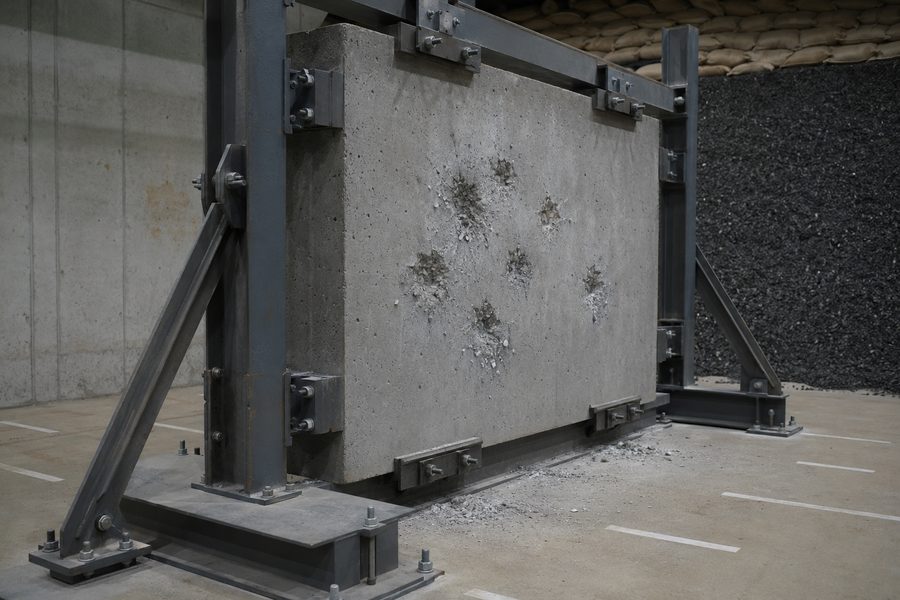
Concrete test panel clamped in a steel test frame at an indoor range, its face marked with ballistic impact craters

Every ballistic product arrives with a claim, and behind every responsible claim sits a test report. The claim is usually one line on a data sheet. The report is several pages long, and the conditions that make the result true are written in those pages. A specifier who reads only the line is accepting a result without knowing what was tested, how it was tested, or whether the thing being bought is the thing that was shot.

This note is written for architects, engineers, specifiers, facility owners and contracting officers who have to accept or reject ballistic submittals. It sets out what a test report should contain, the questions to ask of each part of it, and how to write a specification so that the submittal answers those questions before the product is approved.

Start with the standard and its edition

A ballistic result means something only against a named test method. UL 752, the Standard for Bullet-Resisting Equipment, and NIJ Standard-0108.01, Ballistic Resistant Protective Materials, are common references for building products. Each defines its own test rounds, its own shot patterns and its own pass criteria. A result under one does not translate into a result under the other, and a level or threat designation from one standard has no meaning when it is quoted against the other.

The report should name the standard and the edition it was tested to. Standards are revised, and the round, the velocity window or the number of shots can change between editions. If the report names no edition, or names a different one from the specification, that is a question for the submitter, not a detail to overlook.

Check what was actually tested

A common gap between a claim and a building is the specimen. A report describes a specific sample: its material, its thickness, its dimensions, how it was built and how it was held in the test frame. That sample is what the result belongs to.

A result for a single panel is not a result for a wall built from those panels, because the joints, the fasteners and the frame were not part of the test. A result for a filled block wall belongs to the block, the fill and the reinforcing together, not to the block alone. A result for a door leaf is not a result for the door assembly with its frame, hinges and hardware. The specification should ask the submitter to state which assembly was tested and to show how the assembly being supplied matches it. Where the supplied assembly differs, the difference should be identified and explained, not left for the inspector to find.

Read the conditions that travel with the result

A ballistic result is a statement about a round, fired under stated conditions, at a stated specimen. Each of the following belongs to the result, and none of them should be dropped when the result is summarized.

Seven things a test report should state

If any of these is missing from a report, ask for it before the submittal is accepted. A one-line claim on a data sheet that leaves them out has left out part of the result.

  • The standard and edition. The test method the specimen was tested to, with its year or revision.
  • The testing organization and date. Who conducted the test, where, and when, so the report can be traced to its source.
  • The specimen. Material, thickness, dimensions, construction, age or cure where it matters, and how the sample was mounted.
  • The round. Caliber, bullet type and weight, so the threat can be compared with the threat written into the specification.
  • Velocity and shots. The measured velocity of each shot, the number of shots, their spacing and their pattern on the specimen.
  • Obliquity and range. The angle of the shots to the face of the specimen and the distance from the muzzle.
  • The result for each shot. Whether each round penetrated, and what the witness or indicator material behind the specimen recorded, including any fragments thrown from the protected face.

Watch the protected face

Stopping the bullet is only part of the question. Fragments of the specimen itself can be thrown from the protected side of a wall or panel, and those fragments can injure the people the wall was built to protect. Test methods address this differently, and a report should say what was placed behind the specimen to record it and what that material showed. A specifier protecting an occupied room should read that part of the report as closely as the penetration result.

Match the report to the threat you wrote

A report can be complete and still answer the wrong question. If the specification calls for protection against a rifle fired from a public road, a report on a handgun round does not answer it, however clean the result. If the threat is repeated fire at one area of a wall, a report with widely spaced shots does not answer it either. This is why the threat should be written into the specification first, with the standard and edition named, and the submittal checked against that threat line by line.

The same discipline applies to openings. A wall tested to a threat protects only as far as its doors, louvers, glazing and penetrations, and each of those needs its own report against the same threat basis. A submittal package that carries reports for the walls but not for the openings has left the weakest parts of the protective line untested.

Ask for the report, not a summary of it

A specification should require the full test report for each protective assembly, not a certificate, a letter or a line on a data sheet. It should also state the verbs it will accept. A product that has been tested to a standard can say so, and say what it was tested against. A claim that a product is rated, certified or listed should be backed by the listing organization’s own record for that manufacturer and that assembly, which the specifier can check independently. Language such as “meets” or “exceeds” a standard, without a report, gives the owner nothing to inspect or accept against.

Keep the reports with the building

Close-out documents should file each report with the drawings that show where the tested assembly was installed. Years later, when a wall is opened for a new penetration or a door is replaced, that record is the only way the owner will know which elements were protective, what they were tested against, and what a replacement has to match.

Where Amidon fits

Amidon designs, supplies and installs protective construction, and it treats the test record as part of the product. Amidon publishes its results with their conditions on its testing and test data page, and states which material or assembly each result belongs to. Amidon Shield is used in cast-in-place and precast protective walls and enclosures, and ArmorBlock brings the same material into masonry construction. Amidon’s design and engineering group works with the project engineer to write the threat, select assemblies against it, and assemble the submittal record. For guidance on the wall itself, see writing a ballistic wall specification.

Amidon is a Service-Disabled Veteran-Owned Small Business (SDVOSB).

Testing and test data

Reviewing a ballistic submittal?

Send the threat written into your specification and the assemblies you need to protect. Amidon will respond with an assembly approach and the test records that apply to it for engineering review.

Talk to Amidon