
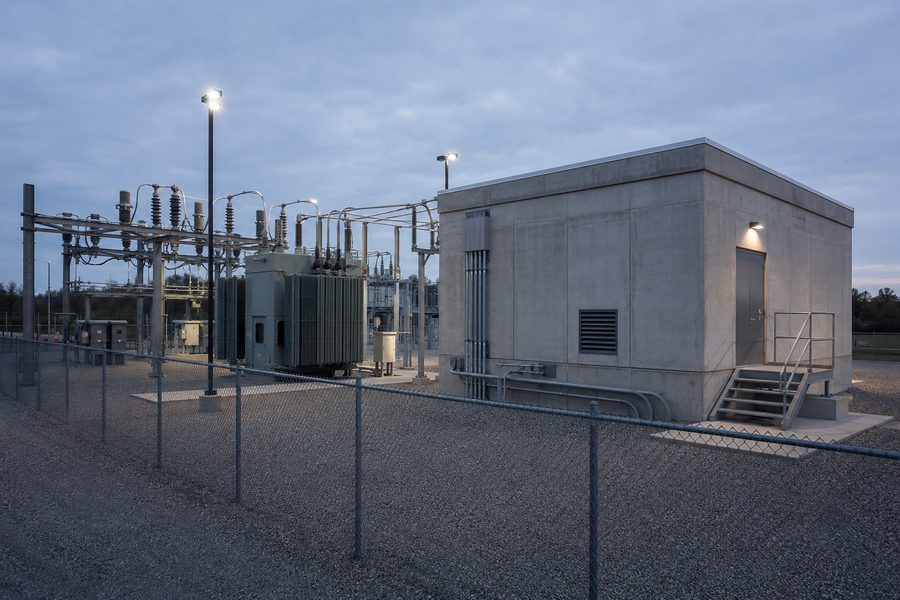
A substation fence does a useful job. It marks the boundary, keeps the public away from energized equipment and gives an intrusion detection system a line to watch. What it does not do is protect anything. A chain-link or welded-mesh fence offers no resistance to a rifle round fired from outside it, and the assets that matter most at a transmission substation, the large power transformers and the control building that runs the station, usually sit in plain view of the fence line.
This note is written for the owners, engineers and security leads who decide what goes inside that fence. It covers the regulatory frame, which assets are worth hardening, and what a specification has to say for protection to show up in the field rather than only on the drawings.
The regulatory frame: NERC CIP-014
For transmission owners in North America, the starting point is NERC Reliability Standard CIP-014, Physical Security. It applies to transmission stations and substations, and the primary control centers that operate them, whose loss could cause instability, uncontrolled separation or cascading within an interconnection. The owner performs a periodic risk assessment to identify those facilities, has it verified by an unaffiliated third party, evaluates the potential threats and vulnerabilities at each one, and then develops and implements a physical security plan that is itself reviewed by a third party.
The plan language is the part that matters for construction. CIP-014 requires resiliency or security measures “designed collectively to deter, detect, delay, assess, communicate, and respond” to the threats identified in the evaluation. It is a performance standard. It does not tell an owner to build a wall, install a barrier or buy a particular product. It requires the owner to show that the measures, taken together, answer the threats the evaluation found.
That structure leaves a real design decision with the owner, and it puts weight on one word in the list: delay. Detection and assessment tell the owner something is happening. Communication and response bring people to the site. Delay is what keeps the asset in service in the time between the two. At a remote substation that interval can be long, and a fence on its own buys very little of it.
Facilities that fall outside CIP-014 applicability face the same physics with less paperwork. Distribution substations, generation interconnections and industrial switchyards are often protected to the owner’s own standard, and the same questions apply to them.
Why the fence is not the protection
A fence is a deterrence and detection layer. It slows a person on foot for a short time, it gives sensors something to monitor, and it signals that the site is controlled. Against a standoff ballistic attack it is irrelevant, because the threat never has to cross it. Against a vehicle, an unreinforced fence is a gate that opens on impact.
Visual screening is a partial step. Opaque fencing or screen walls remove the clear line of sight to a transformer and make it harder to aim at a particular component. Screening is not resistance, though. A screen that hides a radiator bank does not stop a round fired at where the radiator bank is known to be. If the evaluation identifies a ballistic threat, the specification needs material between the threat and the asset that has been tested to stop that threat.